Monday, July 19, 2010

A Guide to Penitential Gardening

Someone clever once said you are never so close to God as when gardening. This is, of course, patently untrue, because we are closest to God when we receive Him in Holy Communion. Flippin' Protestants!

Still, how much closer are we to God when suffering, especially when we suffer willingly for the sake of the God who loved us unto death, even death on a Cross? We can suffer gladly in reparation for our sins, in union with Christ Crucified and offer up these pains for the conversion of sinners, the Church Suffering in Purgatory and perhaps most importantly of all, in these times when a Papal Visit to the UK is starting to resemble a drive in Helmund Province, the liberty and exaltation of our Holy Mother, the Church.

Gardening is a perfect way to mortify the flesh. Are you finding it hard to overcome your fragile, fallen, human nature? Well, aren't we all, but, see, help is at hand. Let nature conquer nature! Let nature herself overpower you! Gardening, if done totally recklessly and in a spirit of outright rebellion to health and safety procedures, will mortify you quicker than you can ask, "So, what really happens at these Opus Dei meetings, then?"

1. Berberis: The sworn enemy of human skin. A shrub that causes even the most hardened and skilled burglar to admit defeat and say, "Ouch...I'm out of here, shall we try number 11?" Just walk up and brush yourself against it at first. Then, once you're getting used to it, climb up a ladder and throw yourself onto the prickliest bush this side of the Grand Canyon.

2. And that't it. Pruning Berberis is a nightmare! If you want self-flaggelation that stuff will do the job in half an hour. Oh, I did disturb a wasps nest last week and found myself running about the garden like a man fleeing a disturbed wasps' nest would. Aaaaargggh! It's a wasps nest! Ruuuuunnn! This evening I passed a lady in the car who I met at the Windmill last year. She's a protestant lady. Unfortunately, or perhaps fortunately, she couldn't remember our having met and my having sat in her lounge debating Pentecostalism and Catholicism with her. I stopped in the car with a couple of friends as she was sitting on a park bench having a drink and asked if she'd like to come to the pro-life vigil tomorrow outside Wistons and whether she had anything she wanted to donate to the Building Fund Car Boot Sale.

She said, "Who was the first person to see Jesus? Mary Magdalen."
I said, "Well, no, the first person to see Jesus was the Virgin Mary, after he was born. Oh, you mean after the Resurrection."
She said, "Why would I want to hassle women at an abortion clinic?"
I said, "Well, its less hassling people and more bearing silent witness to the rights of the unborn to live."
So she said, "Well, I'm pro-choice. I believe in a woman's right to choose."
So I said, "What about the unborn child's right to live?"
She said, "What about women who've been raped."
So I said, "Well, that is not the fault of the unborn child."
So she said, "It's not the fault of the woman either..."

So, the lady rebuked me and said, fixing me with her eyes through her shades, something along the lines of, "My relationship with Jesus Christ goes much deeper than that. Do you know how I can tell a Christian? It's because they're smiling all the time. Whereas when I began to talk to you your face literally fell and a black cloud came over your head and it seemed you were full of hatred."

Clearly, I was unable to contain my horror. I don't think I hated her so much as felt outraged by someone professing to believe in Our Lord expressing views so brazenly against what mainstream Christians believe.  Okay, perhaps my thoughts were indeed sins against Charity. Mea culpa.

So I said, "Well, it's not that. It's just that I was shocked that you were a Christian who did not believe in the rights of the unborn to live."
She said, "Well, I don't believe a lot of things Christians believe."
So I said, "Okay, well the main reason we stopped was to ask if you wanted to come to the pro-life vigil and whether you had anything you wanted to donate to the Car Boot Sale for the Restoration Fund, since you had already given my friend something to sell." Indeed, she had, it was a Tomy baby cot protector.
She said, "No, I only gave him that because I thought he could get some money for it."
I said, "Okay, well we've got to go, bye."
So she said, "Bye, see you in Heaven...maybe!"
I turned around and said, "God bless."

Aaaarggh! It's a wasp's nest! Ruuuuunnn!

You see. The lesson is that you just can't assume that just because someone told you they are a Christian, that they will be pro-life and that our Charity must be sincere so that we don't give Protestants reason to doubt our faith. Still, it is a worry when even Pentecostals don't want to bear witness to the rights of the unborn. I thought we had some things in common!

Bend of the River


Bend of the River (1952) is a fairly middling effort by Anthony Mann standards, which means it's still a pretty solid Western. His second collaboration with James Stewart, it gets few points for originality but succeeds on its own terms as a fine adventure tale.

Gunslinger Glyn McLyntock (James Stewart) is escorting an Oregon-bound wagon train when he comes across Emerson Cole (Arthur Kennedy) being lynched by a band of vigilantes. Glyn saves Cole and the two strike up a friendship, though they part ways when they arrive in Portland. Glyn returns to Portland after his pioneers fail to receive a shipment of food, finding that Cole is set up as a gambler, with pretty farmer's daughter Laura (Julia Adams) as his girl. Glyn, Cole and friendly cardsharp Trey (Rock Hudson) forcibly commendeer the supplies, but run into trouble from a crooked businessman's (Howard Petrie) gang of thugs and Glyn's own mutinous followers - including Cole.

Bend of the River was penned by Borden Chase, who also wrote Howard Hawks's Red River (1948), and it shares many similarities with the Hawks film. Some are generalities to be expected in a wagon train film; other scenes are lifted almost intact (the Indian fight early on, the mutiny). A Fordian element about building a new town in the wilderness is also integrated into the film. The most original element is the McLyntock-Cole dynamic, two "men with a past" who prove poles apart morally. The downside to this, however, is some corny moralizing about "bad apples" and changing a man's nature that Mann expresses only in the most obvious terms.

Despite this, Mann keeps things interesting with well-drawn lead characters, plenty of plot twists and a lot of action, and in fairness the film hangs together much better than Red River, with a climax that's actually cathartic. If the movie is closer to the all-action Winchester '73 than Mann's more sharply-drawn later films, this isn't a bad thing. His later (and superior) The Far Country (1954) would revisit some of the plot elements here, but this is a good trial run, and a fine movie in its own right.

As expected in a Mann film, the scenery is the high-point: Oregon's Mount Hood provides a gorgeous backdrop to most of the action, and Irving Glassberg's colorful cinematography makes the film a visual treat. The movie has some splendid action scenes, particularly the running gun battle through the saloons and streets of Portland, and the final fight between Glyn and Cole.

James Stewart is dependably James Stewart, with the usual Mann-infused edge of neuroses and violence. Arthur Kennedy gets the meatiest role: depth-wise, Emerson Cole isn't a patch on The Man From Laramie's Vic, but Kennedy excells at making Cole likeable yet subtly devious. Julia Adams and Rock Hudson, however, are shafted with worthless parts, and Jay C. Flippen is burdened with one too many speeches about bad apples. There's also a small role for Stepin' Fetchit, who's okay but seems out of place, and Mann regulars Harry Morgan and Royal Dano put in appearances.

Bend of the River is far from Mann's best work, and aside from The Naked Spur probably his weakest collaboration with Stewart. That said, it's still a solid Western with a lot to commend it.

Sunday, July 18, 2010

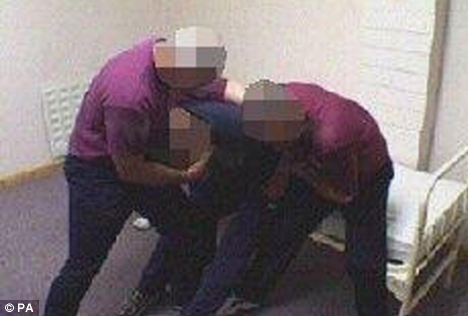
State Cover Up of Child Abuse?

 Courtesy of Daily Mail Online...

'Disturbing' secret manual reveals brutal methods used on youths held in child prisons

A government manual instructing prison staff on how to inflict pain on teenage inmates was today labelled 'state authorised child abuse'.

The Ministry of Justice was forced to release details of its approved 'restraint and (Was it like some kind of a journalistic headlock, do you think?) self-defence techniques' for children in secure training centres after a lengthy freedom of information battle.

The secret manual, Physical Control In Care, authorises staff to 'use an inverted knuckle into the trainee's sternum and drive inward and upward.' It adds: 'Continue to carry alternate elbow strikes to the young person's ribs until a release is achieved.'

The document, written in 2005 but classified as secret, also tells staff to 'drive straight fingers into the young person's face, and then quickly drive the straightened fingers of the same hand downwards into the young person's groin area.'

Instructions to staff warn that the techniques risk giving children a 'fracture to the skull' and 'temporary or permanent blindness caused by rupture to eyeball or detached retina'. The guidance, designed to cope with unruly children, also acknowledges that the measures could cause asphyxia.


One passage, explaining how to administer a head-hold on children, adds that 'if breathing is compromised the situation ceases to be a restraint and becomes a medical emergency'. Carolyne Willow, national co-ordinator of the Children's Rights Alliance for England, said: 'The manual is deeply disturbing and stands as state authorisation of institutionalised child abuse. What made former ministers believe that children as young as 12 could get so out of control so often that staff should be taught how to ram their knuckles into their rib cages? Would we allow paediatricians, teachers or children's home staff to be trained in how to deliberately hurt and humiliate children?'

The campaign for publication began following the deaths of Gareth Myatt and Adam Rickwood. Gareth, 15, died while being held down by three staff at Rainsbrook Secure Training Centre in Warwickshire. he choked on his own vomit and died. In the same year, 2004, 14-year-old Adam, from Burnley, hanged himself at the Hassockfield Secure Training Centre in County Durham.

Phillip Noyes, director of strategy and development at the NSPCC, said: 'These shocking revelations graphically illustrate the cruel and degrading violence inflicted at times on children in custody. 'On occasions these restraint techniques have resulted in children suffering broken arms, noses, wrists and fingers. Painful restraint is a clear breach of children's human rights against some of the most vulnerable youngsters in society and does not have a place in decent society.'

A Ministry of Justice spokesman said the techniques were used 'very infrequently'. She added: 'For young people under 18, the use of restraint is a last resort. But where young people's behaviour puts themselves or others at serious risk, staff need to be able to intervene effectively, to protect the safety of all involved.'

"We only stab inmates in the eyes with our fingers when we really have to." What a surprise. And there were we all thinking that the Catholic Church had the monopoly on brutality, abuse and woeful neglect of the young and vulnerable. Of course, there's no sexual abuse in State care homes and prisons either, its only Catholic Priests that do that, isn't it? 

Important Women in the Church


There are so many aspects to the 'women priests' argument that are at odds with the Church that it is difficult to know where to begin. Theologically speaking, on so many grounds, those who seek a change in Church teaching on this subject (or indeed any subject) are all at sea.

It strikes me that those who campaign for 'women priests' in the Church really misunderstand what the Church understands by 'vocation', as well as the Church's mission as a whole. St Therese of Lisieux joyfully exclaimed that she had found her vocation within the Church. She was, as the large majority of Catholics know, a nun. Surely, anyone who has become a nun, one would have thought, has already discovered their vocation? However, St Therese, because of her great sanctity and profound friendship with Our Lord, suggests that she only discovered her true vocation after she had made her profession to enter a convent. Her vocation was to be 'Love in the Heart of the Church'. She wrote...

"O Jesus, my love, at last I have found my calling: my call is love. Certainly I have found my place in the Church, and you gave me that very place, my God. In the heart of the Church, my mother, I will be love, and thus I will be all things, as my desire finds its direction." 

She didn't say, "O my God. Make them change the rules so I can be a Priest. I can't bear this nun lark!"

The Church, by virtue of Her Holy Tradition and the Sacramental nature of Ordination, the Sacrament having been given Her by Her Founder, Our Lord Jesus Christ, cannot alter Her position on the requirement for Priests to be male. Not only this, but not even every male is considered to be suitable for the Priesthood. I mean, if all of the men who had been told explicitly that their spiritual directors believed that they did not have a vocation to the Priesthood and all of these men formed an alliance called, 'Men Who Wanted to Be Priests But Who Were Told, "You Do Not Have a Vocation to the Priesthood, Try Something Else", Priests Now!' then they would still not be able to become Priests since it would be abundently clear these men have a problem with Obedience.

That is not to say that women and indeed men, do not have a 'priestly' or 'apostolic' mission in the Church and to the World. Every Catholic is really called upon to defend the Church, to proclaim the Gospel and to evangelise by word and deed. St Therese of Lisieux certainly saw her role as missionary, priestly even, but with childlike simplicity and humility understood that her expression of Christ's saving love was different to a Priest's expression of Christ's saving love. A mother's expression of Christ's saving love is different to that of a Priest or a nun as is that of a husband's. Rest assured, however, that Heaven has little regard for human status and mothers, fathers, nuns, single people, Bishops, Priests and the Pope are highly esteemed and loved by God!

Becoming a Priest, is not like becoming a youth worker, or a journalist, a nurse, a doctor or an accountant. It is a Vocation to serve Christ in a special way, to be Alter Christus, 'another Christ', not merely to strive to imitate Him, but to be Him sacramentally. A Priest may or may not have sins many and large, but, regardless, it is Christ who acts through the Priest at the Consecration of the Bread and Wine, Who transforms these species into His Body and Blood. It is Christ Who absolves, through His Priest, the sins of the Faithful in Confession. It is Christ Who, in Baptism, acts through the Priest, bringing a human being into the life of the Trinity, Who bestows Sacramental Grace upon those adopted into the Family of God.

There can be no understanding of the role of women in the Church without recalling the life of the Blessed Virgin Mary, a woman so very highly esteemed by God and honoured above all women ever before and ever to come in human history, that she was spared the stain of Original Sin, having been conceived immaculately and bore the very Son of God Himself in her womb.

There will never be a woman so important in the Church as she. She is so important that we pray to her every Mass. She is so important that we are encouraged to pray to her very regularly indeed, to intercede on our behalf to her Divine Son. She is a model for all not by virtue of what she did, but who she was and is now before the Throne of God. None shall ever be so close to God as she. Look, here she is, literally bestowing the Church and the World with Grace because she is the Mother of God!

I mean, can you imagine being a woman, or indeed man, so important that everyday people get up in the morning and pray to you? St Therese of Lisieux knows how that feels, St Anthony of Padua knows how that feels and the Blessed Virgin Mary definintely knows how that feels...

St Francis of Assisi didn't even think himself worthy of becoming a Priest. He was a man, he was exceedingly holy, he was very humble and let's face it would have made a wonderful Priest, but he entrusted himself to Our Lord Jesus Christ and the Blessed Virgin Mary and allowed Heaven to do the rest.

No matter what heretical authors say, St Mary Magdalen was not a priestess, nor was she Our Saviour's secret lover or wife. Today's Gospel recounts how she sat at Our Lord's feet and just listened to Him. One can imagine she did that a lot, clinging on His every word that left His Sacred Heart and was delivered by His Sacred Tongue. Her part, that of a contemplative, was 'not to be taken from her'.

All the Saints and Martyrs tell us something about God, but their lives tell us that if you want to be important, ask to be delivered from that desire. I'm sure Blessed Mother Teresa said exactly that. Be close to Our Lord Jesus Christ and His Mother, be loyal to your mother, the Church, pray, seek the Face of God, love God and your neighbour intensely and maybe, just maybe, one day, you will be a very important person indeed.

Saturday, July 17, 2010

The Odessa File


Frederick Forsyth's intricate, well-plotted thrillers have proven attractive to film makers, and surprisingly, most of the adaptations have been successful. Fred Zinnemann's The Day of the Jackal (1973) is an unusually faithful screen adaptation, resulting in a brilliant film that nearly equals the book. The Dogs of War (1980) took significant liberties with the source material, but still produced a highly-entertaining movie. (Granted, I have yet to see The Fourth Protocol (1987).)

Which brings us to The Odessa File (1974), one of a string of Nazi refugee films from the '70s (Marathon Man, The Boys From Brazil). Ronald Neame's serviceable adaptation of Forsyth's second novel has the advantage - and disadvantage - of being based on a not-that-great book, but the screen version only accentuates the novel's flaws while adding new ones.

West Germany, 1963. Journalist Peter Miller (Jon Voight) comes across the diary of a dead Jew, Solomon Tauber, who committed suicide. Miller finds that Tauber had been interned in Riga Concentration Camp during World War II, under the brutal control of SS Captain Eduard Roschman (Maximilian Schell). Miller's search for Roschman brings him to the attention of Israeli spies, who want him to infiltrate ODESSA - a clandestine organization of ex-SS officers - and sabotage their involvement in Egypt's rocket program. Unfortunately, ODESSA quickly sees through Miller's disguise and targets him for elimination.

The Odessa File's intriguing premise is largely unrealized. Some of the fault is Forsyth's, for wedding borderline-superfluous elements (the Israeli-Egyptian subplot, Miller's annoyingly-conventional motivation) to an interesting main story. Neame and screenwriters Kenneth Ross (who scripted Jackal) and George Markstein, however, also share part of the blame. The novel could well have been improved upon, but the film's changes serve merely to remove the story's edges, resulting in a wholly conventional thriller with few surprises and little imagination.

Neame amps up the action and violence, inserting and rearranging scenes to little positive benefit. Miller goes from an intrepid reporter to an unlikely action hero, a reasonable-enough route; more objectionable is reducing his motivation to a personal vendetta. Miller's naggy girlfriend (the pretty Mary Tamm) has a lot of screen time but little to do; a menacing assassin is easily disposed-of. The already tacked-on subplot of ODESSA scientists helping Nasser's rocket program in Egypt, is even more superfluous in the film, scarcely mentioned after the pre-credits scene. Dramatic economy is something this film sorely lacks.

The climax highlights a major issue. Miller and Rouschman's meeting is good enough, but lacks the visceral anger - and unconventional conclusion - of Forsyth's equivalent scene; it's an all-too-typical action finale. Miller's eloquent anti-Nazi speech is excised, bringing a major issue into a sharp relief: the film isn't interested, as Forsyth was, in exploring post-war Germany's ambivalence towards Nazism; it merely wants to use the Nazis as a colorful backdrop. On one level, this is fair enough - not every movie can be deeply political - but in so doing, it neuters one of the things Forsyth did get right, removing depth and imagination for predictable drama.

Neame's direction is competent visually, but on top of its other faults, the film's pace is slow and often disjointed. Some scenes are staged with power, particularly the Holocaust flashbacks, but the movie is often static and only fitfully gripping. Having Andrew Lloyd Webber (!) score is another mistake; his very funky, '70s-sounding score often clashes with the tense and serious atmosphere - particularly an ill-advised Christmas theme song (!?!) sung by Perry Como.

Jon Voight does well, making Miller a credible and compelling protagonist. Maximilian Schell (Cross of Iron) is excellent in what amounts to an extended cameo. Mary Tamm is pretty but ill-used; Maria Schell is excellent in her small part. Derek Jacobi (Day of the Jackal) and Noel Willman (Doctor Zhivago) also feature.

Ultimately, The Odessa File is a major disappointment. The book is no literary masterpiece but has virtues and depth that the film lacks; the result is a bland, by-the-numbers thriller, especially weak compared to other Forsyth adaptations.

Pro-Life Display Outside Wistons Clinic


Callings all people in Brighton.

I have received an email from the local SPUC group.


'I wanted to make you aware of a display we are planning to do next Tuesday outside Wistons "clinic". Would you be interested in joining us at some point in the day? We would like to stay as long as we can but need more people to help hold banners. We are aware of one child being led to the slaughter that day but suspect there are more.'

If you are a Brightonian who would like to be present at the display and vigil outside Wiston's Abortuary on Dyke Road in Brighton, please contact Andy at andy@abort67.co.uk.

Andy has asked that I draw your attention to the Abort 67 website, but be prepared for some 'graphic' images which you may find very disturbing and profoundly distressing.

More information to come as soon as I get it.

If you cannot make it to the display...pray!

"This Time Next Year..."

I discovered with great joy yesterday that the Open Market off London Road is running car boot sales every Saturday 8am - 3pm throughout July and possibly every Wednesday in August.

I managed to cram a load of tat (remember Gerald Ratner's big mistake?) from the garage of St Mary Magdalen's today into my car and flog some. It's really incredible what crap people will buy if its a bargain!

Someone offered to buy my car. I said £5,000 minimum. He took my number! If I got that I'd get a half-decent van and start doing this buying/selling scam bigtime. We didn't do half-badly, not that great, but a weekly thing would be a regular source of income for the Building Fund. Who knows, maybe I can begin collecting stuff and make some money myself.

I do love a good car boot sale. Friends have been encouraging me to go to auctions and sell stuff to try and make a living. I've also got the pickles and chutney recipe book waiting if I should get a regular stall somewhere. Among other items, I sold some nice statues of Our Lady and one of St Therese of Lisieux so interest in the Faith is still alive in Brighton. I've no proof they were blessed so I don't think its simony...

Mario, a car boot trader next to me bought the statue of St Therese and told me that his mother, when alive, was visited by St Therese who he said was instrumental at various 'pivotal' points in her life. I remember seeing 'La Vie En Rose', the life story of Edith Piaf and being struck by her devotion to the Little Flower who, according to the film at any rate, appeared promising her protection to her and cured her of blindness when she was very little. He said he'd just started doing car boot sales and it had become already, 'like another religion' for him. I think trading can be a bit like that! Very addictive!

My friend George says he is into the idea as well, going to auctions and the like and getting a van and eventually getting a shop and restoring furniture and musical instruments and the like. Say a prayer for a chap called Ben, (a great blues guitarist, hope you see him in action soon) who I saw on the way home. He got badly beaten up the other week and has stitches. He was sleeping rough for three weeks having got kicked out of YMCA for being 'aggressive'.

I've been to the YMCA before and seen their 'banned' list behind the counter and its very long. I don't understand it. Surely, if you are in the 'business' of running a homeless hostel for alcohol and drug addicts you must be able to handle 'difficult' people! You can't just kick them out every time they lose their rag and leave them on the streets for 3 weeks, with mental health problems and expect everything to be okay for them! Ben said that if all the drug addicts and alcohol addicts suddenly got clean and sorted their lives out all the people who work at YMCA would be out of a job. There is a need for a hostel in Brighton that, having taken the housing benefits cheques from the Government, actually makes an effort to substantially support and help society's most vulnerable, rather than just using them for the funding and then spitting them out...

Anyway, to finish this post, I'd like to point you in the direction of a contributer of The Tablet and lecturer at Roehampton University in Theology who needs some Veritate in Caritas. I expect most people who browse this blog will have already done their solemn duty and given her a good denouncing already in her comments box, having seen Fr Ray Blake's post.

What fascinates and irritates me is that you get some very learned, very clever, highly educated people in this World who either are Catholic or become Catholic, having 'professed' that they believe that all that the Church teaches is true, but who then become obsessed with sucking the Love, Truth and Life out of the Church like bloodthirsty parasites, by constantly demanding that the Church be conformed to their personal ideas of what the Church should be like and demanding that their 'voice be heard'.

Then, on the other hand, you get people in the World who are simple-hearted and humble who just accept that the Church is Holy and cannot err in Faith and Morals and those people are then considered as dumb, stupid and contemptable because they accept what has been revealed by God to His Church. What was it Our Lord said about 'becoming like little children'? Why do these 'theologians' not take Christ at His word! All that education, all that theology and still no closer to the Truth! These heretics always want their voice to be heard, but rarely, it appears will they actually listen to Our Lord or want His Voice to be heard, nor seemingly, that of His Vicar on Earth, currently Pope Benedict XVI, now gloriously reigning.