Showing posts with label Stanley Kramer. Show all posts

Tuesday, June 14, 2011

The Caine Mutiny


The Caine Mutiny (1954) is a superb film on many levels: a powerful character drama, a pictorally-handsome epic and a thoughtful look at the pressures of military command. Producer Stanley Kramer and director Edward Dymytryk were prone to obnoxious "message films," but their adaptation of Herman Wouk's Pulitzer Prize-winning novel is an unqualified success.

Newly minted Ensign Willie Keith (Robert Francis) is assigned to the Caine, a small minesweeper run ineptly by Commander de Vriess (Tom Tully). Keith befriends the ship's officers, steadfast Lieutenant Maryk (Van Johnson) and snide would-be novelist Keefer (Fred Macmurray), but struggles in his first days at sea. Things change when Captain Phillip Queeg (Humphrey Bogart) assumes command. Queeg is a martinet who whips the crew into shape, but his erratic actions - cutting a tow line during a training exercise, turning tail during a military operation - cause his officers to question his competence. An incident involving pilfered strawberries brings Queeg's sanity into question, and Keefer convinces Keith and Maryk that mutiny is the only answer to the Caine's problems.

The Caine Mutiny is superbly crafted. This could easily have been a Mutiny on the Bounty tale of nautical tyranny, but Wouk, Dymytryk and scenarist Stanley Roberts make things far much more complex. Queeg is not a conventional villain, but a badly damaged man with crippling personality flaws. He's seen heavy action in the Battle of the Atlantic, being attacked by one submarine too many. The scenes where he half-apologizes to Keefer for his first rant, and a scenee where he practically begs his officers for help, show that he's all too aware of his shortcomings, even if he's loathe to admit it. Regardless, his obsession with shirttails and strawberries destroys crew morale, and his instability makes him a dangerous man.

The conflict between Keefer and Maryk drives the story. Keefer is marvelously complex, a cynical agitator who nudges Maryk towards mutiny, but an inveterate, self-serving coward in crunch time. Maryk knows something's wrong with Queeg, but can't think of a course of action, allowing Keefer to dictate events. The trial scenes place events in stark relief, showing that the mutiny, while justified by immediate circumstances, was not inevitable. Nor are Keefer and Maryk heroes. Instead of helping Queeg or going through proper channels, they fail to act until events force their hand. This is much more interesting than the usual "When is insubordination justified?" dilemma, which assumes the captain is always at fault.

Dramatically the film is solid, with only a few clunks. The film is marvelously fast-paced, given that it's a straight drama, alternating seemlessly between sweeping ocean scenes and quiet conversations. There's an admirable balance between high adventure and personal conflicts that few films achieve. On the other hand, we spend a lot of time on Keith's romance with a pretty singer (Mae Wynn), a subplot completely disconnected from the story. Greenwald gets a pointed final rant which spells things out for slower audience members. These bows to audience sensibility are forgiveable, however.

Dymytryk toned down the novel's rougher edges to ensure Navy cooperation, but the results seem worth the artistic compromise. Franz Planer's beautiful Technicolor photography makes the film function as an epic even with the focused drama, with use of real Navy ships, archive footage and a few well-placed miniatures. Max Steiner's score feels a bit too bombastic for the material, blaring Navy ballads even as characters plan and deliberate.

This is Humphrey Bogart's best late-career performance. Queeg seems a typical martinet at first, with barely-concealed neuroses, an eye for petty details and an obsession with discipline. But he's a much more complex character than Captain Bligh, a war hero who's simply seen too much combat to function properly but too proud to admit it. Bogart plays the part beautifully, mixing his forceful personality with scarcely-concealed inner pain, allowing us to pity Queeg even in his worst moments.

The supporting cast is phenomenal. Newcomer Robert Francis (The Long Gray Line) gives a superb performance, holding his own against his seasoned co-stars. Sadly, Francis died in a plane crash in 1955, cutting short a promising career. Fred Macmurray (Double Indemnity) has never been better, subverting his usual charm with a wonderfully snide, loathsome character. Van Johnson's (Battleground) conflicted, tormented Maryk is easily his best performance. Jose Ferrer's (Lawrence of Arabia) sardonic attorney doesn't show up until the last forty minutes, but completely steals his section of the film. E.G. Marshall (Nixon) ably plays the Navy prosecutor, and Lee Marvin and Claude Akins (Rio Bravo) can be spotted as sailors.

Strangely, of all the supporting cast only Tom Tully's brief, one-note portrayal of Queeg's predecessor received an Oscar nod. Tully is easily the weakest cast member aside from May Wynn's superfluous love interest.

A few minor flaws aside, The Caine Mutiny is a gripping, superbly made film. Rarely has a movie better explored the difficulties of military command, and the consequences of miscommunication and incorrect action.

Monday, November 8, 2010

Guess Who's Coming To Dinner


I love it when Stanley Kramer descends from Heaven to teach us a lesson we so richly deserve.

Guess Who's Coming to Dinner (1967) is probably Kramer's most famous work. Though not as obnoxiously one-sided as Inherit the Wind, or as boring and pedantic as Judgment at Nuremberg (and, thankfully, not nearly as long as either), it still suffers from the same stilted dramatics and preachy liberalism that made those films a chore. Even as a straight drama and a showcase for its talented cast, Guess Who is a mixed bag.

Headstrong young Joey Drayton (Katharine Houghton) comes home from vacation with her newfound love, Dr. John Prentice (Sidney Poitier). Her parents - liberal newspaper editor Matt (Spencer Tracy) and museum curator Christina (Katharine Hepburn) - are taken aback when they discover - dun dun dun! - that John is black! The two wrestle with their doubts and prejudices, while Joey delivers an ultimatum: she's running away to Geneva with John whether or not they approve! However, John won't agree to the marriage without the Draytons' consent, further muddying the waters. And the situation is further complicated when that rapscallion Joey invites John's parents (Beah Richards and Roy Glenn) over as well! Socially relevant shenanigans ensue.

However daring it was for a Hollywood film to endorse interracial marriage in 1967, Guess Who's Coming to Dinner must have seemed anachronistic. That same year, Bonnie and Clyde and The Graduate hit theaters, and their radical, disaffected edge was more in tune with the era's zeitgeist. While the film was well-received, Guess Who's gentle liberalism seems a relic of an earlier time, with little place in the increasingly-radicalized '60s. This might not be such a bad thing if the drama were more satisfactorily, but it's the usual parade of simplified issues, broadly-drawn characters and preachy theatricals that we've come to expect from Kramer.

The whole premise of the film is hard to swallow. I've often complained about deck-stacking in "message films," but this one takes the cake: John and Joey fall in love in ten days, then come home without notice to Joey's parents. And Joey, either ludicrously naive or needlessly cruel, convinces John's parents to visit as well, and forces them all to make a one-night decision to bless their marriage. Wow. It's nice to think that racism can be solved in 100 minutes, but in real life things just don't work that way. Call me cynical, but I don't have much faith in a ten-day romance either. I guess that's why there wasn't a sequel: Guess Who's Paying Alimony.

Any edge the subject retained is forfeited by its angelic protagonist. Prentice is unbelievably perfect: a successful Doctor, he's completely deferential to the Draytons, lets insults and slurs roll off his back, exhibits no sexual desire or "ethnic" emotions and lacks a criminal record. Played by the saintly Sidney Poitier, he's a white man's fantasy Negro: who wouldn't want this handsome, mild-mannered, improbably successful man as a son-in-law? Kramer proudly claimed that he deliberately made Prentice flawless, but I'm unclear why this is commendable. I know it wasn't in Kramer's nature, but a human being with actual flaws would be more interesting. If Archie Bunker's daughter Gloria brought home Huey Newton for dinner, that would be an interesting film!

Kramer does a better job with peripheral characters and individual scenes. Interestingly, the most overtly bigoted character is black maid Tillie (Isabel Sandford), while the kindly Mosignor (Cecil Kellaway) is the only character with no reservations about the match. Christina gets a big cheer when she tells off her hateful assistant (Virginia Christie). But the requisite monologue ends the film with a big thud, moving from a needlessly-exhaustive plot summary to spelling out the message in excrutiating detail. Mr. Kramer: anyone who needed this lesson isn't going to be swayed by Spencer Tracy hectoring them at length.

Spencer Tracy plays his usual avatar of liberal rectitude, albeit with a bit more nuance as he fights his inner reactionary. But he still gets to deliver his trademark preachy monologue where he encourages us to be good, tolerant liberals. Katharine Hepburn is obnoxious as usual, though to be fair, she scales down some of her usual tics and mannerisms. Sidney Poitier is straight-jacketed: when he lets emotion show through - his showdown with his father, his love scenes with Joey - he shines, but for the rest of the film, his flawless black man is unbelievable. Katharine Houghton is just plain annoying. The more interesting characters are on the periphery, with Beah Richards (The Miracle Worker), Cecil Kallaway (Harvey) and Isabel Sandford (TV's The Jeffersons) providing fine performances.

On the whole, Guess Who's Coming to Dinner is another tedious Stanley Kramer Lesson in Liberalism. It has its merits, and it's not as obnoxious or painful as other Kramer vehicles, but it's really hard to swallow its stilted dramatics and broadly-drawn characters. Oh well.

Thursday, February 4, 2010

Inherit the Wind


If there's one thing I hate about social drama films, it's deck-stacking. In fiction, you obviously have the liberty to tell whatever story you want, however you want. But if you're trying to get a point across, you ought to do it in a somewhat believable or balanced manner, or your end product will seem like whining or preaching. Making a complex issue into a simple tale of good and evil usually hurts the drama.

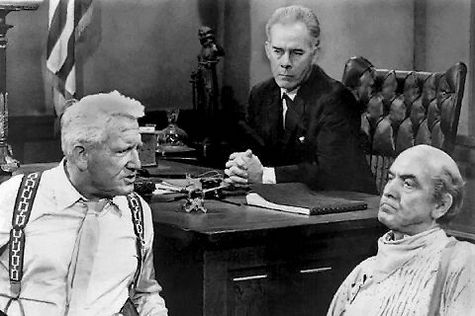
Stanley Kramer's adaptation of Inherit the Wind (1960) is a case in point. Loosely based on the real-life Scopes Monkey Trial, Wind boils down the complex politics and media circus surrounding the trial into a titanic clash of righteous atheists and bigoted Christians. It's not that the issues explored aren't of interest - I certainly agree with the film's take on the separation of Church of State and the importance of free speech - but it rigs the drama in an unsatisfactory way. Not only that, but the alterations make things less dramatic than in reality, sabotaging any justification for dramatic license. For all the histrionic fireworks of Spencer Tracey and Frederic March, Inherit the Wind is hamstrung from the get-go.

In a small Tennessee town circa 1925, science teacher Bertram T. Cates (Dick York) is arrested for teaching evolution to his students. The case gains national attention, and the local citizenry capitalizes off the trial, bringing in populist politician Matthew Harrison Brady (Frederic March) to prosecute. Cates' friends and relatives enlist atheist attorney Henry Drummond (Spencer Tracy) for his defense. The two men square off in the hot courtroom, igniting the air with inflammatory forensics, in a contest of logic and reason against bigotry and narrow-mindness. All seems lost until Drummond puts Brady on the stand, exposing the evangelically-minded prosecutor for a fool.

Inherit the Wind does not claim to be a documentary, so criticizing its myriad inaccuracies seems inappropriate. Problem is, the dramatic license employed here hurts rather than helps the drama. The real-life Scopes Monkey trial was a media circus exploited by both sides for publicity; the ACLU had Scopes teach evolution specifically to provoke a showdown over Tennessee's anti-evolution statute. As the film portrays, the people of Dayton, Tennessee had a field day with the trial, gaining welcome attention and tourist revenue in the resultant hullabaloo, and both atheism and Christianity exploited the trial for their own ends. The outcome of the trial put separation of church and state in the forefront of American consciousness, but actually achieved little - Scopes was, after all, found guilty, and the law remained on the books for years.

With visions of Joe McCarthy dancing in their heads, Jerome Lawrence and Robert E. Lee crafted this story into a straight-forward clash of ideas. What results is an okay drama that takes the easy way out, simplifying all the drama and players into comfortable conventionality. I don't condemn the film for taking dramatic license, but rather the way it uses said license; it gains little from its various distortions of fact. Why change interesting, complex facts into a predictable, simplistic story?

The film is starkly black-and-white in its portrayal of righteous, freedom-loving atheists facing down self-righteous Christian tyrants. While the real William Jennings Bryan was an intelligent man well-acquainted with Darwin, Lee and Lawrence's Brady is a babbling, long-winded moron easily dispatched by a few bon mots. Drummond, the Clarence Darrow analogue, is an obnoxious, self-righteous prick, which might be fine the film owned up to it. He's not unlike Ibsen's Dr. Stockmann, an insufferable jackass we're inexplicably supposed to root for. Drummond gets all the good lines, makes all the good points, resulting in a didactic and slanted drama that eventually grows tiresome.

Compared to something like Elmer Gantry, which criticizes a specific type of Christianity, Wind's unnuanced portrayal of religion does little credit to the drama. It's easy to argue the righteousness of your cause when you portray your rivals as uniformly bigoted morons; much harder when, like the real Bryan, they are anything but. The attempts to make Brady sympathetic towards the end come off as half-assed and disingenuous - he seems more pathetic than anything. The movie's gestures towards tolerance are especially rich coming from the obnoxious Drummond character; his lecturing the hectoring reporter (Gene Kelly) about Brady's past greatness seems like a bad joke after the past two hours of defamation.

The basic story is undeniably compelling. Trial films, particularly those involving conscience and free speech, are almost always compelling. Using real-life trial transcripts and a cast of fine actors, Kramer and his writers create a film that's never boring. Indeed, moments of it are excellent, particularly Drummond and Brady's reminiscence over their shared past, and it's not bad as a straightforward drama of conscience. However, variations of it have been done many other times, from The Passion of Joan of Arc and The Crucible to A Man for All Seasons and Becket, and often better. And Cates' penalty - a $100 fine - seems paltry compared to being burned at the stake, beheaded or pressed to death.

Kramer's direction is fine, making use of some excellent, moody cinematography. The film's oppressive atmosphere is undeniably effective, from the chilling opening to the oppressive, steamy court room. The use of music is quite excellent, particularly the refrains of Old Time Religion, emphasizing the fiery determination of the small-town bigots. The movie is just cinematic enough to be more than a mere filmed play, while allowing the drama to succeed or fail on the shoulders of its script and cast.

Spencer Tracey gives one of his best performances, infusing Drummond with fierce determination and strength of will. His conversion to tolerance isn't particularly convincing, but that's the fault of the script, and Tracey handles these scenes with the appropriate dignity and gravitas. Frederic March is equally impressive, overcoming the limitations of his character and making him almost compelling. Gene Kelly is appropriately snarky as the journalist, and Dick York, Donna Anderson, Harry Morgan and Claude Akins all give fine supporting turns.

Inherit the Wind is a mixed bag. As a straightforward drama of conscience, it has its merits, particularly due to its excellent cast. As an attempt to explore the Scopes trial and related issues, it's really empty, shallow, and one-sided. I agree with the message, but wish it had been explored in a better, more nuanced work.

Wednesday, December 10, 2008

High Noon


Last night TCM showed one of the all-time classic Western, Fred Zinnemann's High Noon. I had watched the film many years before, and remember not having been crazy about it, but I decided, now that I'm a committed cinephile, why not give it another go? Especially considering my high regard for Zinnemann's other work, and the fact that I had nothing else to do but study, it seemed like it was worth a rewatch.

Well, it was, but surprisingly my opinion has little changed since I was a 14 year old. As a film, High Noon has its virtues: a fine cast amd excellent direction and editing in particular. But for all its hype as an intelligent, "adult" Western, with lots of political baggage (begin rant about the blacklist and ignorant confusion of Joe McCarthy and HUAC here) and "deep" themes, it's hopelessly confused. I think DVD Savant's review of this film says what I want to say, and better, but I'll give it a go regardless.

In case you don't know the plot: Will Kane (Gary Cooper) is the long-serving Marshall of Hadleyville, who wishes to marry committed Quaker Amy (Grace Kelly) and retire. Unfortuantely, his old nemesis Frank Miller (Ian McDonald) has other plans; he's been pardoned from jail and is headed back to town with three henchmen (Sheb Wooley, Robert J. Willkie, and Lee Van Cleef) to seek revenge. Kane tries to organize a posse, but finds the townspeople indifferent, scared, or outright hostile, and his wife is unwilling to stand by his side. Finally, Will must go it alone, facing four vicious outlaws in a climactic showdown for the ages.

High Noon has always been read as the ultimate parable about a man sticking up for what's right. If that's the level you want to address the film on, it works well-enough. Will Kane is a curious character. He is a rugged individualist, who is willing to sacrifice himself for the sake of a town that appears to loathe him. This isn't necessarily believable on a personal level - especially considering the horrible, repeated backstabbing we see him go through - but as a character type - the ultimate Good Guy, facing up to the Evil no matter the cost - he makes a very strong impression. On this level, the movie works, not the least for Gary Cooper's wonderfully dignified, straight-laced performance. Whatever the faults in his character motivation, Cooper's performance successfully transfigures Kane into an emblem of individual righteousness, making at least one of the film's major strands work perfectly.

The movie really stumbles, however with its story and plot - or rather, the way it goes about them - and supporting characters. This movie is perhaps the ultimate exemplar of characters being merely cogs in a story rather than believable people. It takes an unbelievable amount of convenience and contrivance to bring the movie to the point where Kane is forced to make his lonely stand, and some of the techniques employed by Foreman and Zinnemann are heavy-handed to the point of being insulting. Upon further reflection, a lot of them don't even make sense.

The whole movie is a series of carefully orchestrated events designed to lead to the inevitable conclusion, depriving Kane of support and leaving him standing alone, and very little of it works - simply because, frankly, it doesn't make much sense. Why aren't these people willing to stand up to Miller? It's fair to assume that the rowdy saloon crowd might like Miller, and even some of the town's more unscrupulous businessmen would prefer him to the upright Kane, but the arguments advanced by some of the town's leading citizens are just ridiculous. Thomas Mitchell's grotesque speech in the Church is perhaps the biggest example - he's worried about one day of violence besmirching the town, but presumably letting Miller and Co. have free reign in the town will be good for them? The contrivance of Kane's deputy (Lloyd Bridges) being an ambitious prick willing to sell out the town for his own sake doesn't really come off either, nor really is the judge (Otto Kruger)'s fleeing at the first sign of trouble. Amy's character is even more problematic; her opposition to violence seems warped and out of place (would a Quaker really side with a vicious outlaw gang over the law?), and her taking up arms to save her man is a crude and sick joke. It's rather bizarre that a leftist would write a screenplay advocating such an openly pro-violence, pro-individual and anti-society message, but here you are.

Even worse, the movie continually undercuts its message - which it seems is that people are just no damned good - through its own actions. Kane himself notes that several members of the surly saloon crowd had helped him put Miller away all those years ago. What exactly "changed", as one of them helpfully says, that they're now either cowards or openly siding with Miller? The movie could have addressed this, but it completely skirts the issue, merely setting Kane up for another fall. The fact that many are willing to help Kane, only to disappear into the woodwork when it's convenient for the story make it all the more aggravating; what happens to the four guys who immediately jump up to help at Kane's appearance in the Church? Was their sense of right and wrong destroyed by listening to a speech? What about the rest of the Church congregation who vehemently argue Kane's side (including Virginia Christie's poignant appeal: "What's WRONG with you!?"), or the children who look up to him? These good characters are swept under the rug due to story convenience, providing a horribly one-sided and inaccurate even within the film's frame of reference view of things. When Kane throws his star into the dirt at the end (a big fuck you to the assembled townspeople), we're presumably supposed to forget all the good people who are in the town. If that's the way he feels, then why did he bother sticking around in the first place?

More troublesome still are the film's alleged "political" meanings. Carl Foreman was a committed leftist, and heavy-handed political preaching was his biggest liability as a writer (even his escapist works like Guns of Navarone was unable to escape this), but any attempts to read the film as a blacklist parable aren't very pertinent to me. I'm sorry, I find it extremely hard to see any parables between a sheriff standing up to a gang of outlaws and Hollywood actors being; the fact that the threat comes from outside the community rather than from its government further complicates things (and might make an alternate reading, of Kane standing up to the insidious Commies and their pinko friends, possible). Maybe in the most abstract way one could read it as such, but any direct analogy is extremely problematic. It seems to me a case of critics making up stuff after the fact; Foreman was blacklisted, so this film must be about the blacklist! Sorry, I ain't buying it.

Technically, the movie is extremely accomplished, and this is the area where it is most successful. Zinnemann's direction is quite handsome, handling both his fine cast, the mise-en-scene, and the action scenes with aplomb. This movie is much more gritty than Zinnemann's later polished, handsome films, and yet he doesn't seem a bit of place. The movie's real ace, however, is the editing by Elmos; the use of clocks throughout (the film being in almost real-time), and the use of montage (particularly the intercutting of the main cast members just before the final showdown) provide brilliant tour-de-force works of editing. And the final showdown is among the best the genre has to offer, skilfully directed, choreographed and edited. It's very hard to fault the flm on this level, though I for one find the Tex Ritter score to be horribly annoying.

The acting is good for the most part, in spite of the characters they have to play. Besides Cooper, Katy Jurado's sexy, vibrant Mrs. Ramirez, Lloyd Bridges' selfish punk deputy and Thomas Mitchell's backstabbing friend come off best. I've never been a big fan of Grace Kelly and as usual she's adequate but little more. It's also nice to see future Western vets Jack Elam and Lee Van Cleef in small roles.

So, High Noon has its virtues as a film, but its story relies on too much contrivance to really work. I think a 7/10 rating would be more than fair.

Rating: 7/10 - Recommended