Sunday, June 23, 2013

How to halt The Tablet in one easy move

Close the Tablet - Tabula Delenda Est!


Tyburn Tree has posted on Facebook, with a suggestion  of how to call a halt to The Tablet and its utterances, in particular, criticising Pope Emeritus Benedict XVI.

As with all good ideas, it has simplicity at its base.

Here is what TT has to say on the matter:-


       "This is just a thought. 
                      Perhaps people who attend Westminster                 
                   Cathedral could be encouraged to desist  
                    from putting money in the collection until  
                  such time as the Tablet is removed (and 
                      write to His Grace to that effect)".

Great idea. But why restrict it to Westminster Cathedral?

Why not withold normal weekly donations to the collection plate?

Always provided, of course, that you attend a parish where The Tablet is on sale.

If the thought of holding back your dues is worrying you, why not just place the money in a safe place pro tem and then pay up once the offending rag has been removed?

 For good.

Seems a sound concept to me.

Nothing focuses the attention of their Lordships better than a reduction in turnover.

So please....desist.....yes, desist......DESIST!


The Conversation

"I'm not afraid of death, but I am afraid of murder."
The unsung masterpiece of '70s cinema, Francis Ford Coppola's The Conversation (1974) is every bit as accomplished as The Godfather. Coppola seamlessly blends paranoid thriller with incisive character study, anchored by Gene Hackman's incomparable performance.

Harry Caul (Gene Hackman) heads a crack audio surveillance team. They're contracted by the director (Robert Duvall) of a major corporation to spy on a young couple (Cindy Williams and Frederic Forrest). Harry's habitual distance from his work disintegrates after listening to the tapes: it sounds like his subjects fear being murdered. Harry gets no answers from his contractor and no support from his partners; against his better judgment he starts investigating the case.

At first glance, The Conversation fits neatly alongside Nixon-era thrillers like All the President's Men. But Coppola makes few references to contemporary events: one character mentions bugging presidential candidates, while Harry watches a news report on Watergate. Coppola's concerned with paranoia of a more visceral sort: individuals using technology to pry into others' lives. Let's face it: Web cams, Facebook and data mining make privacy obsolete. Who cares about NSA info gathering when anyone with a laptop can access your personal history?

The Conversation closely resembles Blowup with shades of Rear Window: the protagonist thinks he witnesses a murder, but can never prove his suspicions. Like David Hemmings in the Antonioni film, Harry's limited by both the technology employed and his own perception. He plays the tapes endlessly until he deciphers a cryptic message. The suspicious actions of the Director's assistant (Harrison Ford) fuel rather than dissuade his interest. Yet is he really hearing what he thinks? Harry only places himself in danger by prying.

Coppola delivers a film comfortably experimental in a way modern Hollywood scarcely tolerates. The opening long shot of San Francisco's Union Square accompanied by electronic buzzing sets the tone; when we first see Harry's crew they're arranged like snipers. Coppola films mostly in long and medium shot, allowing the viewer to share Harry's uncertainty. And how about that ghoulish shot of blood gushing from a toilet? Walter Murch's sound design plays an integral role, whether Harry's rewinding tapes and focused noise or letting his nightmares bleed into reality. It's hauntingly accompanied by David Shire's minimalist piano score.

But The Conversation also shows a palpable portrait of loneliness. Unattractive, poorly dressed and introverted, Harry lives in a tiny apartment, finding solace only in jazz and Catholicism. His unwillingness to connect with people drives away his partner Stan (John Cazale). There's no Grace Kelly to spur his quest, only a sad girlfriend (Teri Garr) who doesn't know his birthday. He's thoroughly uncomfortable at a buggers' convention and its pathetic after-party. Nor does he enjoy his work: he's hounded by competitors like Bernie (Allen Garfield) and guilt-ridden over a job resulting in murder. He's not content to remain a voyeur, but his imperfect understanding seems to make things worse.

Gene Hackman never had the attractive charisma of contemporaries like Dustin Hoffman and Al Pacino, yet his gruff, low-key style landed him diverse roles: Bonnie & Clyde, The French Connection, even Young Frankenstein. He portrays Harry Caul masterfully, hiding the character's isolation and self-loathing beneath an impassive exterior, revealing his backstory only in a dream sequence. Anyone who habitually spends their Saturday nights alone (raises hand) can empathize with Harry's plight, even in its extreme incarnations. This isn't only Hackman's best work, but among the finest performances in screen history.

John Cazale adds another pitiable sad sack to his resume. Stan worships Harry, endlessly talking him up to strangers, yet even he grows tired of his partner's coldness. Young Harrison Ford makes a strong impression as a shifty villain. Allen Garfield (The Stunt Man) steals his scenes as Harry's snotty competitor; Teri Garr and Elizabeth McRae provide a sympathetic female presence. Frederic Forrest's small but pivotal role presages appearances in Coppola's Apocalypse Now and One from the Heart. Robert Duvall appears unbilled.

If The Conversation lacks the commercial hook of The Godfather or the wild surrealism of Apocalypse Now, it's still one of Francis Ford Coppola's greatest achievements. It culminates in Harry destroying his apartment looking for a bug, then collapsing, exhausted, playing his sax amidst the wreckage. Never has isolation felt so poignant, paranoia so frightfully raw.

Saturday, June 22, 2013

Much Ado About Nothing (2013)

It's a testament to Joss Whedon's flexibility that, while on break from The Avengers (2012), he created the antithesis to that box office behemoth. In just two weeks he assembled a slew of actors from his past shows and films, tweaked a well-loved William Shakespeare play and shot it in crisp black-and-white. The result is Much Ado About Nothing (2013), an enjoyably off-beat take on Shakespeare's best comedy.

Returned from "the wars," Don Pedro (Reed Diamond), Claudio (Fran Kranz) and Benedict (Alexis Denisof) visit the home of local Duke Leonato (Clark Gregg). Claudio instantly grows smitten with beautiful Hero (Jillian Morgese) while Benedict resumes a long-running feud with Beatrice (Amy Acker) - a feud which masks deep-seated affection. While friends and family connive to unite the feuding couple, Pedro's brother Don John (Sean Maher) has more malign plans. Along with partners Borachio (Spencer Treat Clark) and Conrade (Riki Lindhorne), he schemes to separate Claudio and Hero. Things go awry, relying on bumbling Constable Dogberry (Nathan Fillion) to set things right.

This blogger always found Much Ado easier-going than Shakespeare's other comedies. It lacks the overdone plot of Twelfth Night, the implausibility of Merchant of Venice, the repulsive sexual politics of Taming of the Shrew. The story's pretty flimsy but Shakespeare's witty lovers Beatrice and Benedict mouth some of the English language's best comic writing. Kenneth Branagh's splashy 1993 version holds up well, despite some egregious stunt casting (Michael Keaton and Keanu Reeves?); it's hard to imagine a better screen couple than Branagh and Emma Thompson. 

Whedon conjures a straight modern dress adaptation, with modern affectations that emphasize the story's ridiculousness. Dogberry comes on like a sad, RayBan-wearing Dirty Harry wannabe, viciously interrogating Borachio and Conrade like serial killers. Benedict ponders the horrors of marriage while sitting next to a dollhouse; Beatrice trips over her laundry while overhearing her maids' conversation. Yet Whedon smartly allows the text, and more importantly the cast, to carry the show. He's helped by Jay Hunter's unfussy black and white photography, with only a few flourishes (flashbacks, a dreamlike masquerade ball) to fill in story gaps.

Practically every actor's a veteran of Buffy the Vampire Slayer, Angel, Dollhouse or The Avengers. Alexis Denisof dives whole hog into Benedict, whether mouthing Shakespeare's "oyster" soliloquy or performing push-ups for a bemused Beatrice. Amy Acker proves equally appealing, dispatching her barbs with wit and self-possession. Jillian Morgese makes a likeable Hero while Reed Diamond and Frank Kranz have fun with characters usually played as wet blankets. As Don John, Sean Maher at least purges memories of Keanu Reeves's dude-tastic turn. Clark Gregg overdoes Leonato's mugging, but he's such an agreeable presence it seems mean to criticize.

Much Ado About Nothing is a refreshing experience. In this summer's sea of sequels, superheroes and general junk, it provides a beacon of wit for those demanding more than explosions.

Pray for the Pope


I can't quite express how I feel about this Sanctuary, but I think the above could be described as a post-Renaissance masterpiece.

His Holiness is reported to have said of a concert at which his attendance was expected, "I am not a Renaissance Prince who listens to music instead of working."


This could be received as a sideswipe at His Holiness's predecessor, who loved music and concerts. The Pope is now and always will be Successor of St Peter, the Prince of the Apostles and has various titles that connote a Sovereign or Monarch. If we did not believe this we should have to believe that the Chair of St Peter was empty, which makes the image above doubly freaky.

If His Holiness does not want to fulfill the duties placed upon him as Pope, why did then Cardinal Jorge Bergoglio accept the Office of the Papacy? Every Bishop in the World has things to which he will be expected to attend. Not every Bishop actually enjoys Fairtrade craftsales or the Nativity at a local school.

For some reason, when I think of this Pontificate, I keep thinking of this great film entitled 'The Madness of King George', which is ironic really, because the Pope is called Jorge. Pray for His Holiness. I'd be right gutted if asked to play guitar for the Pope and His Holiness didn't show because he thought he was above such nonsense, which naturally, he would be. It's a bad analogy, but hey ho...Pray.

Pray for Ireland at a Pontifical High Mass


New Pope, New Face in the CDF?

Liberation theology? No, not for me.
When Pope Benedict XVI appointed Archbishop Gerhard Müller as Prefect of the Congregation for the Doctrine of the Faith, was he naive or just trusting?

Questions like this are today worth attention as Archbishop Muller heaps praise on 'liberation theology' as a development that "should in my opinion be included among the most important currents in 20th century Catholic theology."

Among the most important currents in 20th  century Catholic theology? The 20th century. Not a great century for Catholic theology, then. Liberation theology was the Church's answer to Marxism, because, basically, it was Marxism, despite what Archbishop Müller says. It pointed to Christ as Liberator, not of those enslaved to sin, but as liberator of peoples in class struggle and if that happened through violence, it did little to condemn that violence. This is what led Pope Benedict XVI as Cardinal Ratzinger and Prefect of the CDF to say of it:

'An analysis of the phenomenon of liberation theology reveals that it constitutes a fundamental threat to the faith of the Church. At the same time it must be borne in mind that no error could persist unless it contained a grain of truth. Indeed, an error is all the more dangerous, the greater that grain of truth is, for then the temptation it exerts is all the greater.'

Of course, not all 'important currents' are good and praiseworthy, so we can hope that Archbishop Müller went on to criticise liberation theology. That is, we can hope in vain, as the new head of the CDF has form. As Vatican Insider says:

'The arrival of the Catholic Church’s first Latin American Pope made it possible to look at those years and experience without being conditioned by the controversies that raged at the time. Without the ritualism of the false mea culpas and superficial changes, it is easier today to see that the hostility shown by certain sections of the Church towards the Liberation Theology movement was politically motivated and did not really stem from a desire to preserve and spread the faith of the apostles. Those who paid the price were the theologians and pastors who were completely immersed in the evangelical faith of their people. They either ended up in the mince or faded into the shadows.

For a long time, the hostility shown towards the Liberation Theology movement was invaluable factor in helping some climb the ecclesiastical career ladder. In one of his speeches, Müller (who in an interview on 27 December 2012 suggested it was likely a Latin American would substitute Ratzinger as Pope) did not hesitate to describe the political and geopolitical factors that had influenced certain “crusades” against the Liberation Theology movement: “the satisfaction of depriving the Liberation Theology movement of all meaning was intensified by capitalism’s sense of triumph, which was probably considered to have gained absolute victory. It was seen as an easy target that could be fitted into the same category as revolutionary violence and Marxist terrorism,” Müller said.

It would be great if the CDF could challenge this Archbishop on his eulogy of liberation theology, but unfortunately, the head of the CDF is an advocate of liberation theology. Cracking. Didn't Our Lady of Fatima say something to suggest that the dogma of the Faith would be preserved in Portugal, but, by implication, could be lost anywhere or everywhere else - even in Rome?

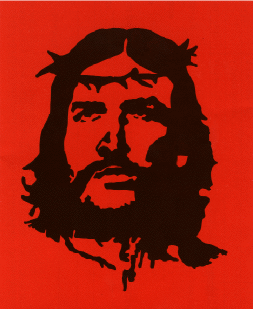
A pictorial summary of liberation theology
The Church's condemnation of liberation theology? Ah, well, it was just a little rule. I have no doubts that the Holy Father is perfectly orthodox and His Holiness himself is said to have fought liberation theology in Buenos Aires, but one really does get the impression that those who promulgate error have been emboldened by the election of a Successor of St Peter who has such little regard for customs, rules, disciplines and norms.

Perhaps the Cardinals chose a Latin American Jesuit who would be popular on purpose. The popularity of the Pope takes the heat off their wayward doctrines, beliefs and lifestyle. After all, as others have said, turkeys don't vote for Christmas. Certain members of the Church's hierarchy obviously see in Pope Francis a 'soft touch'. Out of love for the Church, His Holiness's love for the Bride of Christ, I would like to see Pope Francis take a break from the cuddly Pope parade and get a little bit tough on those who promote error and endanger souls. Where better to start than at the CDF?

Liturgical dancing was the norm long before Vatican II

In the 14th century, St Beryl formed an order of nuns, known as the Berylians,  who soon became known as 'the leaping nuns' due to their spiritual practice of leaping.

The vintage clip below shows the Mother Superior, circa 1965, being interviewed from their only convent in Britain, in Norwich.