Showing posts with label Sam Peckinpah. Show all posts

Sunday, April 21, 2013

Servant Dundee: Blu-Ray News

Recently two excellent films received a Blu-Ray release.

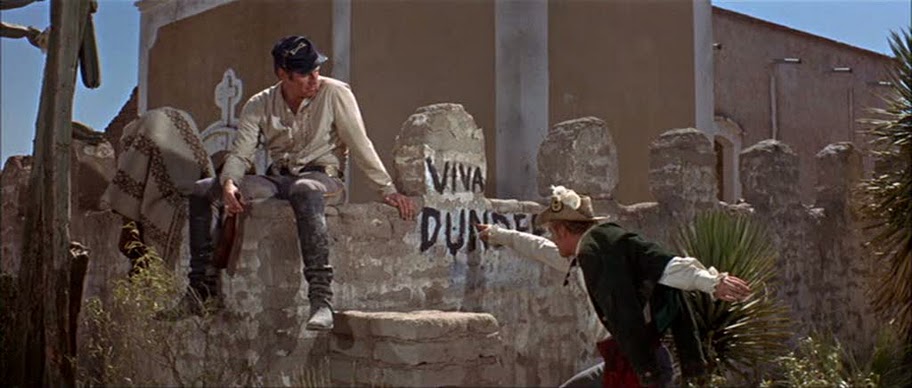
First comes Groggy's long-time favorite, Sam Peckinpah's Major Dundee (1965). The one person who loves Dundee as much as me is Glenn Erickson, aka DVD Savant; he provides another lengthy essay on the film. Blu-Ray.com has screencaps here. Sadly Daniele Amfitheatrof's original score isn't provided with the 134 minute cut, only the 121 minute version. Boo.

Even more interesting is this interview by Darren Gross, conducted with Helen Samuels, who played Mary Rostes in Dundee's infamous lost opening. This confirms beyond any reasonable doubt the Apache massacre was filmed. Credit Savant with a genuinely groundbreaking piece of research!

Groggy reader Michael O'Sullivan, who maintains his own blog at Mike's Movie Projector, tipped me off to a new Blu-Ray release of Joseph Losey's The Servant (1963). Mike provides some thoughts here. Blu-Ray.com has a review and some screencaps here; looks excellent. Looks like Losey's Accident (1967), unseen by me, also received a release. Somehow I don't think The Assassination of Trotsky is next.

Enough classic talk. Scathing reviews of awful movies to come later. You've been warned.

Thursday, October 13, 2011

Fall in Behind the Major


Courtesy of Tim O'Brien, friend, fellow-blogger and former second-in-command, I came across this awesome Major Dundee blog. For the eight or so of us who are die-hard fans of Major Dundee, this is a must-see.

It's possible I'll go see a theatrical release this weekend, or maybe I'll just stay home and watch old Westerns. I have Saturday off from work for the first time in six weeks so anything is possible.

Friday, April 15, 2011

Junior Bonner


Sam Peckinpah is best-remembered for the bloody mayhem of The Wild Bunch and Straw Dogs, which isn't entirely fair. Peckinpah was equally capable of low-key, thoughtful films. Ride the High Country has its share of gunplay but the elegiac and somber tone sticks in the memory. The Ballad of Cable Hogue's gentle romantic comedy is the complete opposite of The Wild Bunch's nihilism, even with Strother Martin and L.Q. Jones in supporting roles.

Junior Bonner (1972) is Peckinpah's most down-to-earth film. A small-scale slice-of-life drama, it's far from Peckinpah's best work but still has plenty of modest charms.

Junior Bonner (Steve McQueen) is a master rodeo cowboy who comes home to Prescott, Arizona after sustaining an injury riding Sunshine, a particularly nasty bull. He finds things changing for the worse: his brother Curly (Joe Don Baker) has gone into real estate, planning to sell the Bonner family estate for houses. His dad Ace (Robert Preston) is in the hospital, planning to move to Australia to mine gold, with long-suffering mom Elvira (Ida Lupino) threatening to leave him. Junior looks for a rodeo manager (Ben Johnson) to let him have one more crack at Sunshine.

Junior Bonner plays, fittingly enough, like a modern Western. The decline of the rodeo circuit allows for Peckinpah to indulge his thematic obsessions. Junior is less eloquent than Pike Bishop, angry at the changing world around him but unable to stop it; even his last "blaze of glory" achieves nothing. Peckinpah's themes of selling out are channelled in interesting ways, with Curly selling the family land and Ace looking for new horizons. Peckinpah and writer Jeb Rosebrook eschew the usual cliche of the heroes fighting change. The protagonists know progress is inevitable and are too beaten-down to fight it.

Peckinpah's direction is controlled and focused, allowing Lucien Ballard's photography to capture some beautiful scenery while remaining mostly down-to-earth. "Bloody Sam" incorporates his trademark slo-mo flourishes and rapid-editing style into a few scenes, with mixed results. The rodeo scenes make great use of it, but the bar room brawl mixed with a tender love scene comes off as forced.

Steve McQueen does fine work, dialing down his persona for his quietly desperate protagonist. Robert Preston and Ida Lupino give excellent performances as Junior's weary, beaten-down parents. Joe Don Baker gives a fine performance, miles away from his embarrassing ham in Mitchell and Walking Tall. Bill McKinney (The Parallax View) has a small part, and Peckinpah regulars Ben Johnson and Dub Taylor pop up in supporting roles.

Junior Bonner is a fine little film even if it's not a masterpiece. At the very least, it shows Sam Peckinpah is capable of quiet, small-scale character drama as surely as over-the-top violence.

Friday, October 15, 2010

One-Eyed Jacks


Once upon a time, Twilight Zone creator Rod Serling was commissioned to adapt Charles Nieder's novel The Authentic Death of Hendry Jones, a heavily-fictionalized reworking of the Billy the Kid story. From there the script passed on to Sam Peckinpah, then a TV writer with a flair for dialogue (Gunsmoke, The Rifleman), with Stanley Kubrick signed to direct and Marlon Brando to star. Kubrick fired Peckinpah and hired Calder Willingham. Completing this confusing round-robbin, Kubrick himself was sacked, leaving Brando - with no directoral experience - to helm the film himself, with Guy Trosper finalizing the screenplay.

The result of this mess is One-Eyed Jacks (1961), an off-beat, frustratingly uneven "adult Western" that alternates between brilliant and dull. For all the story's overbaked psychology, one suspects director Brando is at fault: a more seasoned director could have made something brilliant out of the material. As it is, we're left with an intriguing curio that doesn't live up to its potential.

Outlaws Rio (Marlon Brando) and "Dad" Longworth (Karl Malden) go their separate ways after a bank heist in Mexico, with Rio being nabbed by Mexican police and serving a long, hard prison sentence. Several years later, Rio joins up with a gang of crooks led by Bob Arnory (Ben Johnson), intending to rob the Monterry, California bank. Much to Rio's chagrin, he finds that Monterry's Sheriff is Dad, a completely-reformed man. Rio broods and equivocates, trying to decide how to confront his old pall, while romancing his daughter (Pilar Pellicer) and as his gang grows more impatient.

Many of One-Eyed Jacks's flaws can be traced back to its shavetail director. Brando is a competent director in some regards: the movie certainly looks nice, with lots of beautiful coastal scenery, and the shootouts are creatively handled. But Brando clearly doesn't have a handle on the craft's finer points, much to the film's detriment. The story drags like nobody's business, with a brilliant opening half-hour and tense finale buttressed by lots of flabby bloat, with endless scenes of characters sitting around talking, thinking and scheming. At 141 minutes, the movie is way too long and could have used some judicious trimming.

Of course, Brando isn't solely to blame for the mess. The bizarre written-by-committee script doesn't even begin to get a handle on its potentially-interesting characters. Rio and Dad are polar opposite characters who are more similar than different, and their rivalry brings to mind Anthony Mann or Sam Peckinpah's directoral efforts. But their relationship is bogged down in overwrought psychobabble that obfuscates more than it reveals, and the characters remain half-baked. A lame romance with Dad's daughter just wastes time, and the Freudian subtext isn't as fascinating as the film thinks it is. Mealy-mouthed, pseudo-pretentious dialogue doesn't help either. The combination of first-time director and messy script probably made the film's weakness inevitable.

That's not to say the film is without its charms. The cast is mostly good, the scenery is nice and Brando stages a number of creative shootouts, including the finale where Rio employs a move not often seen in Westerns. Sam Peckinpah's contributions are hard to miss, with several key scenes lifted wholesale from Arthur Penn's The Left-Handed Gun, including a tense square dance and a lengthy jailhouse faceoff between Rio and a surly guard (Slim Pickens) - bits that would find their way into Peckinpah's own Pat Garrett and Billy the Kid. In large part, however, the good elements serve to highlight the weaknesses.

Marlon Brando the actor is good, even if he's a bit too old for his role: his brooding Method style transfers better to the Old West than Paul Newman's similar turn in The Left-Handed Gun. Karl Malden (On the Waterfront) gives a typically fiery performance, but Katy Jurado (High Noon) is wasted in a peripheral role. Pina Pellicer's placcid love interest brings the narrative to a crawl. Slim Pickens (Major Dundee) does surprisingly well against-type as a surly prick, and dependable hands Ben Johnson (The Wild Bunch), Elisha Cook Jr. (Shane) and Hank Worden (The Searchers) turn up in supporting roles.

Basically One-Eyed Jacks is an intriguing misfire. It's probably as good as its troubled production would have allowed, but it's hard to think a more experienced director could have made something great. A Stanley Kubrick Western - now that might have been something to see!

Wednesday, February 10, 2010

Convoy


From one great director's dregs to another...

Convoy (1978) is an awful film, and arguably the nadir of Sam Peckinpah's career. It's possible that no film based on a C.W. McCall novelty song could have been good, but the inebriated, coked-up Peckinpah doesn't come close, delivering an incomprensible, inexplicably self-important mess. To be sure, it has significant camp value, but from the director who gave us The Wild Bunch and Straw Dogs it's a complete head-scratcher. That it was Peckinpah's highest-grossing film shows there is no sanity in the movie world.

Jesus, how to describe the plot? Trucker Rubber Duck (Kris Kristofferson) and his friends Pig Pen (Burt Young) and Spider Mike (Franklyn Ajaye) get into a scrap with crooked cop Dirty Lyle (Ernest Borgnine) and flee, taking troublemaker Melissa (Ali McGraw) along for the ride. This results in a spontaneous, mile-long convoy of truckers. The media and the Governor of New Mexico (Seymour Cassels) mistake this for some sort of political protest, and the Duck is bewildered by his fame. When Spider Mike is laid low by some racist cops, Duck and his boys break him out of the jail, leading to a showdown with Dirty Lyle and the National Guard.

Convoy is just an inexplicable mess. The early truck stop brawl pretty much encapsulates the film: its use of slow-motion, rapid cutting, splattering red fluids (here, ketchup) and children cheering on the violence seems like a bad self-parody. Indeed, slow-motion is employed throughout, the cast bristles with Peckinpah veterans, and a truckload of "Jesus freaks" sings Shall We Gather at the River?, pathetically reminding us of Peckinpah's better work. Peckinpah himself even has a bizarre cameo. It seems like Bloody Sam is apologizing for the film he's making, and his attempts to inject social commentary and Christ allegories into the mix only add insult to injury.

The movie is unfocused and rambling, its pathetic "plot" just an excuse to get a crapload of big rigs on the road. The dialogue is hilariously bad, and I'm not surprised to learn much of it was ad-libbed. If you can't laugh at lines like "I am Officer Bookman, and I hate truckers!" and "Piss on you, and piss on your law!", you're dead inside. The film espouses a childish anarchism which makes no sense: the solution to the world's problems is to get in a truck, drive, and smash things. That's not a worldview, that's a temper tantrum. The half-assed social commentary - the racism directed at Spider Mike, the opportunistic Governor - are really misplaced. The hectoring lyrics of the titular song serve as an obnoxious narration that further sours the deal.

Peckinpah was stoned out of his gourd, and not really interested in the material anyway, leaving it to his second-unit directors. To be absolutely fair, there are some cool images throughout the film, especially the opening shots of Rubber Duck's rig driving through a wind-swept desert landscape. There are some well-staged stunts, particularly Dirty Lyle's car shearing the rooftop of a barn, but the endless shots of trucks on the move gets tiresome fast. Really, unless you have a hard-on for car crashes and big rigs, there's not enough substance to keep a person interested.

Kris Kristofferson (Pat Garrett and Billy the Kid) is a monotone, gravel-voiced parody of machismo, and an unusually-ugly Ali McGraw (The Getaway) again shows her complete lack of talent. Having trimmed her hair and scorched her flesh in a microwave, she's removed her only excuse for walking in front of a movie camera. These two have as much chemistry as a 5th grade science class, and as we have many long scenes in the truck with them, that's a pretty big drawback.

The supporting cast is equally out of sorts. Ernest Borgnine chews scenery with relish, and his delightfully hammy performance is the one bright spot. He, at least, knows what kind of film it is. Burt Young (The Killer Elite), Franklyn Ajaye (The 'burbs) and Madge Sinclair (Coming to America) give half-assed serious performances, and Seymour Cassel's (The Royal Tennenbaums) obnoxious politco is tacked on.

If there's anything good to say about Convoy, it's the camp value, and it's less painful to sit through than The Killer Elite, who only had random ninjas to redeem it. Still, aside from some cool crashes and kitsch, it's pretty much a waste of time.

Monday, November 30, 2009

Cross of Iron


Cross of Iron (1977), Sam Peckinpah's only war film, is something of a disappointment. As with Pat Garrett and Billy the Kid, it's an interesting movie, but one can't help but think a more sober, reasonable early-career Peckinpah - the one that produced Ride the High Country and The Wild Bunch - would have made a masterpiece out of it. As it stands, Cross of Iron is still interesting and fairly entertaining, but far from a masterpiece, with many serious flaws.

It is 1943, and the German Wehrmacht is being overrun by a Russian counterattack. Oblivious to his army's declining fortunes, aristocratic Captain Stransky (Maximillian Schell) turns up to take command of a company of bedraggled troops. Stransky makes clear his primary goal is to win the Iron Cross, seeing the medal as merely an appropriate decoration for his social status, rather than something to be won for heroism. Stransky instantly clashes with Sergeant Rolf Steiner (James Coburn), an embittered non-commissioned officer who's seen more than his fair share of combat, and has some archaic notions of honor, loyalty and heroism. When Steiner refuses to endorse Stransky's bid for an Iron Cross, Stransky takes revenge by leaving Steiner's platoon behind - forcing Steiner and his men to undertake a hellish forced march through enemy lines, before setting up the final showdown between Steiner and Stransky - in the midst of a Russian offensive.

The biggest problem with Cross of Iron is its lack of subtlety. The message is loud and clear: officers are evil and reprehensible cowards, letting enlisted men to die like dogs while capitalizing off of their sacrifice. This is a valid point, albeit an unoriginal one, but it's as subtle as a neon sign. Stransky is a caricature evil officer; he introduces himself by outright stating his only goal is to win an Iron Cross, not even masking it as a joke. He baits two officers into admitting their homosexuality and to blackmail them. During his first battle, he cowers and hides in a bunker, then brazenly demands a commendation for heroism. Later, he leaves Steiner's platoon behind and, even later, orders his men to machine-gun Steiner's troops. Although he has glimmers of humanity (his one-on-one with Steiner about the importance of the Cross), Stransky never rises above the level of caricature. James Mason's Colonel Brandt and David Warner's Kessel are presented more sympathetically, but they're completely impotent and ineffectual (Kessel suffers from dysentery to emphasize the point), only emphasizing the message.

In any case, Steiner hates them all, as he makes clear in a speech to Brandt and Kessel. This serves as a self-defeating character trait, as Steiner is unwilling to help Brandt punish Stransky for cowardice. One might accept Steiner's viewpoint as valid, but one would also hasten to add that it's counterproductive. If he hates officers so much, why not go after the really nasty ones? Steiner is just a bitter, angry, cynical man, not without reason, but it's clear (as with many Peckinpah characters) that he thrives on combat, making his stance somewhat ambiguous and even self-contradictory. That may be the point, but it doesn't really endear us to Steiner.

That all might be excusable (Peckinpah, after all, never was much for subtlety), except that the entire film has an inescapably anemic feel. Major scenes lack the power they should; whether it was Peckinpah's own state of mind, or the film's low budget, the movie pretty much lacks any real force or drive. The major confrontations between characters seem forced; the battle scenes, with one major exception, lack the visceral power that one would expect of a Peckinpah film. The movie certainly has its share of effective moments: the first battle is a doozy, impressive considering the budgetary restraints, Stransky's baiting the two officers, the scenes of German soldiers struggling to remain sane between battles, Steiner's hallucinatory hospital stay - but they're counter-balanced by the weak, cliché and trite sequences that riddle the film. The confrontation between Steiner's platoon and a group of Russian women soldiers is a great idea that fizzles out almost before it begins. The scene where Steiner spares a Russian POW, only to see him machine-gunned by his own men, is rather trite. The final showdown between Steiner and Stransky is well-done but the conclusion is just baffling. The overuse of photo and video montage over the opening and closing credits provides another clunky note. (One might also point out that the use of Wermacht soldiers as protagonists is a novel idea that ultimately comes to very little.)

The acting is pretty good, with James Coburn giving arguably his career-best performance as the embittered Steiner - yet another "Peckinpah professional" trapped in an inescapable circle of personal hell. Maximillian Schell (A Bridge Too Far) gives an intense performance, managing to overcome the cartoon constraints of his role. James Mason and David Warner comport themselves admirably, but they can't overcome their weak roles. Senta Berger (previously of Peckinpah's Major Dundee) has a brief but effective role. There are many talented German actors filling out the supporting cast - Klaus Lowich, Roger Fritz, Dieter Schidor, Burkhard Driest - who give memorable characterizations.

Cross of Iron is a very mixed bag. It's entertaining enough, but really it lacks much in the way of depth or originality. Perhaps if Peckinpah had laid off the coke while shooting - or, better yet, been given a reasonable budget to work with - we could have a very good film on our hands. Instead, we have an interesting film that exists mostly as a "what-might-have-been".

Friday, November 20, 2009

The Killer Elite


It's no secret that Sam Peckinpah, the once-masterful director of Ride the High Country, The Wild Bunch and Straw Dogs, saw a massive exponential decline of talent as his intake of alcohol and nose candy increased. Exhibit A is The Killer Elite (1975), a complete and utter mess of a movie. In different hands it could have been an okay brainless action movie, but steeped in almost gleeful incoherence and idiocy, and cartoonish '70s paranoia, it's a disaster. That it's a Peckinpah film just adds insult to injury.

Mike Locken (James Caan) and George Hansen (Robert Duvall) are a pair of freelance assassins working for a private company who does dirty work for the CIA. During a job, Hansen kills one of their charges and cripples Mike (but inexplicably doesn't kill him). Eager for revenge, Locken takes on a new job: protecting a Chinese politician (Mako) targetted for assassination by a rival crime boss - the team of assassins led by Hansen. With his own team of killers - psychotic Jerome (Bo Hopkins) and mild-mannered driver Mac (Burt Young) - Mike seeks his revenge and sticks it to his former bosses as well.

On paper The Killer Elite has a glimmer of potential, but in practice it's completely squandered by Peckinpah's lazy, clearly-disinterested approach to the material. Instead of a straightforward revenge narrative/spy thriller (which could have made for a passable if cliched shoot-'em-up), the movie opts for incoherence; the film has no narrative drive, no flow, character motivations dropped whenever convenient (or not), scenes having seemingly no connection with one another. The fine cast - Caan, Duvall, Arthur Hill (A Bridge Too Far), Mako (The Sand Pebbles), Burt Young (Rocky), Bo Hopkins (The Wild Bunch) - seems monumentally bored with the material. The film engages in snarky half-baked cynicism about the CIA and US government that comes off as a lazy kick in the post-Watergate gonads.

As expected, Peckinpah handles the action scenes reasonably well, with a modicum of creative editing (eg. a running martial arts battle intercut with a briefing scene), but with everything else lacking, shootouts in isolation can only provide so much enjoyment. In any case, the final scene with Caan battling ninjas on a cruise ship using a walking cane ruins any small amount of good will we've mustered.

I don't feel like writing an in-depth review. Just take my word in these four paragraphs that this film sucks and watch The Wild Bunch again.

Thursday, July 2, 2009

Pat Garrett and Billy the Kid


Perhaps even more than the infamous Major Dundee, Pat Garrett and Billy the Kid (1973) is touted by Sam Peckinpah fans as a lost masterpiece, ruined by studio interference. This is certainly valid to an extent, especially given the cruel cutting and micromanaging wrought by MGM's James Aubrey, but on the other hand Peckinpah himself brought on many of his through his excesses of drink and drugs. The result is this curious, interesting but unsatisfying film, which is great at times but never quite the sum of his parts; it's Peckinpah's most schizophrenic film, alternating scene to scene from brilliant to indifferent to outright bad.

In early 1881, Pat Garrett (James Coburn), an aging outlaw, is elected Sheriff of Lincoln County, New Mexico. He is pressured by Governor Lew Wallace (Jason Robards) and business interests to track down former partner William H. Bonney, alias Billy the Kid (Kris Kristofferson) and his gang. Bonney is captured but escapes, killing two deputies (Matt Clark and R.G. Armstrong), and Garrett - accompanied by several reluctant and generally short-lived deputies (Slim Pickens, Katy Jurado, Jack Elam, Richard Jaeckel) and one hired to keep an eye on Garrett (John Beck) - is forced to track down his former friend, decimating his gang in the process. Garrett is made to feel guilty over "getting fat" and betraying Billy, and when he finally confronts the Kid, it seems like he's killing himself.

The biggest problem with Pat Garrett, even in its "preview cut" form (I'm not touching the God awful 2005 edit with a ten-foot stick), is that it's unfocused and virtually plotless; only a few characters appear for more than one or two scenes, and most scenes play as isolated episodes. It is also a surprisingly distant film, especially compared to Ride the High Country and The Wild Bunch, and it's virtually impossible (for this writer at least) to become deeply involved in the story. Billy in particular is hard to care much about, as he does little more than drink, kill, and whore throughout the course of the film, with only the thinnest and most facile motivation given to his actions. And the theme that Garrett and Co. are selling out is expounded upon so often that you think Rudy Wurlitzer was getting paid for each time he wrote them.

The film's use of various Western icons in various bit parts actually (with a few exceptions) undermines what Peckinpah is trying to achieve; by not letting us get to know these characters, it becomes virtually impossible to sympathize with them. Slim Pickens' famous death scene is allegedly the most poignant and moving scene in the film, but as we just met him two minutes ago when he buys it, it's hard, for me anyway, to care what happens to him. One might argue that Pickens' own iconography and backstory bring weight to the character, but I'm not buying it; Once Upon a Time in the West employs a similar strategy in employing Henry Fonda, Jack Elam and Woody Strode as villains, but on the other hand the film works on its own terms. If this argument has any validity, it's saying that Pat Garrett is basically an in-joke for Western buffs - and I don't buy that as much of an argument.

Some cast members are outright terrible: John Beck is obnoxious as Poe, and while that's appropriate to the character he grates on the viewer's nerves. A very young Charles Martin Smith whines his way through the opening scene as a particularly obnoxious cohort of Billy's. Emilio Fernandez, so effective as General Mapache, has a worthless role as Paco, the Mexican sheep-farmer who befriends Billy, and his scenes are some of the worst Peckinpah ever filmed. Richard Jaeckal gives a wooden performance and his horrible-looking wig doesn't help matters. But most of the cast members simply aren't around long enough to make much impact - Pickens, Jurado, Paul Fix, Dub Taylor, Elisha Cook Jr., Jason Robards, and Barry Sullivan (among many others) are all in the film for five minutes or less, just long enough for a viewer to recognize them before they bow out. Bob Dylan's bit has little impact on the film; his twanging, whining, droning music, however, is borderline terrible. It might be good outside of the film, but for the most part it distracts from the action and makes the film periodically insufferable.

The film does, however, have sporadic moments of brilliance, starting with James Coburn's performance as Garrett. Coburn gives the best performance of his career, as the sarcastic, biting, fatalistic Garrett. He is a nice counterpart to Deke Thornton, but even more compromised and fatalistic. Garrett genuinely regrets most of his actions - many of his confrontations with Billy's gang are outright murder - but does them anyway, driven by a cruel sense of duty and inevitability; he knows that times are passing him by but does his best to stay alive, regardless of the cost. Coburn is wonderfully subtle and you believe he IS Garrett, rather than acting the part. Kris Kristofferson is good if unremarkable as Billy, though he can hardly be blamed for the poor interpretation of his character. And there are some members of the supporting cast who are effective: Richard Bright and L.Q. Jones as two of Billy's more colorful gang members, R.G. Armstrong, playing the psychopathic Deputy Ollinger ("Repent, you son of a bitch!"), and Chill Wills as a gutter-mouthed, shotgun-toting bartender.

Peckinpah's direction is sporadically brilliant. The shootouts of the film are blunt and violent and lack the visceral thrill of The Wild Bunch's blood-soaked massacres. This is not a criticism; in fact, it is very effective. The film's art direction is wonderfully authentic; the whole film has a rustic, lived-in, worn-out look that adds immeasuribly to the film's depressed atmosphere. There are some truly brilliant sequences sprinkled throughout; the shootout at Billy's hideout and Billy's escape from jail, the chance encounter and duel between Billy and Alamosa Bill (Jack Elam), Garrett's "shootout" with a river barge, the slow, methodical murder of Holly (Bright) by Garrett, Peckinpah's cameo as a coffin maker, Garrett shooting a mirror after killing the Kid. All of these scenes individually are among the best work Peckinpah has ever done; it's shame they don't gel into a more pleasing whole.

Pat Garrett and Billy the Kid is a difficult and frustrating film to write about. For every good scene there's one that makes you scratch your head and ask "What the hell's going on?" It's a good film with occasionally great scenes, but it's far from a masterpiece.

Rating: 7/10 - Recommended

Sunday, June 21, 2009

Straw Dogs


Having suffered through nothing but rewatches the last week...

American astrophysicist David Sumner (Dustin Hoffman) is a wimpy pacifist who grows tired of the strife and violence raging across America. Along with his pretty young wife, Amy (Susan George), he travels to George's hometown in Cornwall, England. Sumner quickly finds that beneath the idyllic scenery and veneer of small-town friendliness lie a clannish society based on violence and exclusion-ism. A group of townspeople begin playing a series of increasingly vicious pranks on David and Amy, culminating in Amy's rape by two of the more repulsive townspeople (Del Henney and Ken Hutchison). Things still continue on, until David takes in the village idiot, Harry Niles (David Warner), after hitting him with a car and tries to save him from a mob who saw him abduct a young girl. David tries to sort the situation out peacefully, but before long he finds himself resorting to violence to defend himself and his home.

Straw Dogs is an amazingly powerful film, and a widely misunderstood one as well. Critics who seem unable to analyze films on anything but surface meaning accuse it of glamorizing sadism, misogyny and violence; feminists harp on the film's rape scene and the portrayal of Amy, denouncing the film as a male chauvinist fantasy. Both readings of the film are wholly off-base. Although perhaps not as deep as some of Sam Peckinpah's other works, it's easily his best shy of The Wild Bunch, and deals with a deep (and disturbing) topic: humanity's lust for and glorification of violence and death.

Say the name Sam Peckinpah to anyone and what comes to mind? In pretty much every instance, the answer is violence. Graphic violence, slow-motion shoot-outs with bright red blood spurting out of bullet wounds. This is a simplistic way to look at Peckinpah; in his best work (Ride the High Country, The Wild Bunch) he created deep themes and well-rounded characters worthy of a classic novel or play. Even some of his weaker efforts, like Pat Garrett and Billy the Kid and Cross of Iron, have interesting ideas to present, even if not entirely successful. But, it is certainly true that violence - its effects, its terror, its place in society, and, most of all, social enjoyment of it - is a central theme of Peckinpah's films. Merely judging Straw Dogs on the fact that it IS violent is childish and simplistic; it's much more fruitful to address WHY Peckinpah opted to make it violent, and what he's trying to say.

Straw Dogs is perhaps the ultimate distillation of Peckinpah's views on violence. Peckinpah was an ardent fan of Robert Ardrey, the playwright-anthropologist who hypothesized that humans are inured to violence by instinctual urges rather than social pressure or upbringing. This is a very hard view to argue with, for in spite of hypocritical denunciation of violence in the media, the raging street violence, crime, warfare, and violent action movies, TV shows and video games, indicates that the human race thrives on and revels in killing - no matter how much we may like to think otherwise.

Straw Dogs endorses Ardrey's world-view: the people of our out-of-the-way hamlet are easily driven to violence, their sins mostly overlooked by the hypocritically pious town leaders. Even a pacifist like David Sumner is not immune to the allure of murder; his claims of standing up principle (defending Niles, the murderous village idiot, from a mob) are dubious at best. The film has been read as a revenge fantasy a la Death Wish, which is ridiculous; Amy doesn't even tell David about the rape, so that sort of revenge is not really on the table. Rather, it's a cumulative revenge; a man stuck in a small town with no friends, fed up with violence in his own culture, his taunting and torment here, his unhappy marriage to his wife, and his own weakness, allows his long-repressed rage to explode. In the end, even David Sumner is capable of horrific violence; not only that, he enjoys it. And the sheer visceral thrill of watching vile bad guys get handed their just deserts implicates us in the violence as well; none of us are innocent, and all of us are guilty.

Peckinpah's direction is effective, presenting violence in all its glory and horror; he succeeds at showing an externally beautiful but inwardly hideous small town. The cast is good, if unspectacular: Dustin Hoffman embodies David Sumner as impotent professor and makes his transition frighteningly believable. Susan George is quite good as Amy, the confused, repressed young girl who married a guy who isn't right for her. The supporting cast is adequate, with T.P. McKenna and Del Henney giving the strongest performances as the well-meaning but ineffectual Sheriff and the most sympathetic of David and Amy's tormentors.

Straw Dogs is a powerful, disturbing mediation on violence, with a power and force that few films a possess. It is a true masterpiece.

Rating:
10/10 - Must-See

Wednesday, June 10, 2009

The Getaway


Sam Peckinpah's moribund career and shattered artistic reputation were rescued by The Wild Bunch, which put him back on the map partly for his talent as a storyteller, but mostly for its nihilistic, stylized violence. In the early '70s he made two atypically quiet and personal films, The Ballad of Cable Hogue and Junior Bonner, as well as the infamous Straw Dogs, a powerful mediation on violence that cemented Peckinpah as Feminist Public Enemy #1.

The Getaway was the first of several films Peckinpah made expressly for the sake of box-office returns, along with The Killer Elite, Convoy and The Osterman Weekend - all films where Peckinpah was (ostensibly) under studio control, and therefore couldn't give a damn about the quality of the final product. The movie is based on a Jack Thompson novel, with perennial icon of cool Steve McQueen (who had worked with Peckinpah on Junior Bonner) and talentless but attractive Love Story star Ali McGraw. The film was a big hit when released, with many Peckinpah partisans and crime movie fans arguing its virtues, but perhaps due to directorial indifference, it doesn't really hold up: it fails as an action film and is too slight to work as a thriller.

Doc McCoy (Steve McQueen) is a small-time hood who is sprung from jail by crime boss Jack Benyon (Ben Johnson) as part of a convoluted robbery scheme. Doc and his wife Carol (Ali McGraw) will help Benyon's henchmen Rudy (Al Liettieri) and Jackson (Bo Hopkins) hold up a small Texas bank and split the loot afterwards. The bank job is botched, with Jackson killed by his double-crossing partner, while Doc and Carol manage to come away with most of the money. Our two protagonists attempt to flee Rudy, who kidnaps a bewildered small-town couple (Sally Struthers and Jim Dodson) to help him out, Benyon's henchmen, and state troopers, and escape to Mexico with the loot.

Despite claims to the contrary, The Getaway is really more of a poorly-executed Hitchcock-lite suspense thriller than a shoot-'em-up action film, with only a handful of mostly brief action scenes and precious little Peckinpah flair. There are flashes of slow-motion, the pre-requisite squibs, a plethora of talented character actors, and the omni-present children watching violence, but otherwise this movie could be the work of pretty much any Hollywood hack. The movie is really a long chase in pursuit of the money - or would be, if anyone was actually doing the chasing. As it is, the plot is extremely slight, with very little tension or real development. There's the potential for a good film here, but Peckinpah - or at least Peckinpah under studio constraints - is not the man to make it work.

The movie is extremely slight in every department that counts. Our protagonists are unlikeable and little more than pencilled in; they do little more than bitch about their fractious relationship in between the movie's scant action scenes, which bogs down the plot and quickly becomes tiresome. Besides those two, the movie is completely lacking in characters, the movie's villains an afterthought. Treacherous crook Al Liettieri spends too much time with horny Sally Struthers and bewildered Jack Dodson, in unfunny and tedious scenes that hopelessly bog down the film. Ben Johnson's menacing crime boss is dispatched early, and his henchmen hardly figure into the film until the climactic three-way shootout at the hotel.

This might be forgivable if there were any action or entertainment going on, but there's too much driving, bitching and lengthy hotel and dialogue scenes that are as dull as they are long, making the film a chore to sit through. The plot creeps along at snail's pace, with lots of digressions (the lengthy scene with a confidence man (Richard Bright) trying to make off with the loot) and cliches (there are at least half a dozen variations on the old "Convict enters store, store owner hears about convict on the radio, convict slips out in the nick of time" cliche). The movie's final shootout is well-staged but it's hardly Peckinpah's best work, and it's certainly not worthy of the excrutiating build-up. The movie's contrived happy ending strikes a false note and is a lame capper on an already suspect film.

Steve McQueen seems to be simply going through the motions, taciturn and grim but lacking the charisma and star power that made his best performances (The Sand Pebbles, Papillion) so memorable. Ali McGraw is even worse; she's certainly gorgeous but she has no screen presence, and she and McQueen (future husband and wife) have about as much screen chemistry as a pair of wet noodles). Al Liettieri and Sally Struthers are annoying as all get out, though Jack Dodson is hilariously pathetic as Struthers' bewildered husband. The supporting cast consists of fine character actors doing what they do best: Ben Johnson as the Texas crime boss, Slim Pickens as a talkative truck driver, Dub Taylor as a hotel clerk, Roy Jenson and John Bryson as thugs, and Richard Bright in a scene-stealing bit as a conman who tries to swindle our protagonists.

The Getaway is a mostly dull, mediocre effort from Peckinpah that can be easily skipped by anyone not a hardcore fan.

Rating: 5/10 - Mediocre

Monday, June 1, 2009

The Wild Bunch


Let's start June out with a bang, shall we?

Pike Bishop (William Holden) is the aging leader of a motley collection of outlaws (Ernest Borgnine, Warren Oates, Ben Johnson, Edmond O'Brien, Jaime Sanchez, Bo Hopkins) who try to pull off one last score in 1913 Texas. But a robbery goes horribly wrong when bounty hunters led by railroad detective Harrigan (Albert Dekker) ambush them, leading to a bloody massacre. The Bunch flees into Mexico, pursued by a posse led by Deke Thornton (Robert Ryan), Pike's ex-partner. The Bunch finds themselves working for bloodthirsty Federale Mapache (Emilio Fernandez), who is trying to suppress Pancho Villa's revolutionaries - but their loyalty is conflicted when Angel (Sanchez) turns out to be a member of an Indian tribe oppressed by Mapache. After robbing a US Army arms shipment, the Bunch allows Angel to take some guns for his tribe - but Angel is captured by Mapache and brutally tortured. Finally, Pike, "tired of being hunted" and sick of himself, leads the gang in a desperate last stand.

The Wild Bunch is an American masterpiece. Best-known for revolutionizing big-screen violence, Sam Peckinpah's magnum opus is far more than just a blood-soaked splatter-fest. It's the distillation of Peckinpah's world-view - corruption, moral ambiguity, changing times and men, the horror and glamor of violence, and the complex nature of honor and loyalty. Any misguided critic who views Westerns as outdated popular entertainment needs to watch this film; it has enough character, narrative and thematic depth to put many novels to shame, a combination of Shakespearean tragedy, Hemingway's musings on masculinity and destruction, and Conrad's mediation on guilt and heroism.

Indeed, The Wild Bunch is a cinematic novel. It portrays the theme of doomed men struggling to outlive their time, and the inherent impossibility of doing so. Men like Pike, Dutch, the Gorch Brothers, and Deke Thornton are products of their time - men who are clever and cunning but not particularly intelligent, who live by a Code, and who see violence as a way of life. In this new era, honor and loyalty are irrelevant; Harrigan and his scruffy bounty hunters are concerned only with personal profit, which, as Pike himself admits, "cuts an awful lot of family ties". Even the Bunch's unity is questionable: the surly Gorch Brothers dispute Pike's every move; grouchy old Sykes is a grumbling, cackling liability; and the idealistic Angel traps the Bunch into an unwitting death. Only Dutch remains unremittingly loyal to Pike, but ultimately, they HAVE to stick together in order to stay alive - they simply have no other choice.

Pike Bishop is a fascinating creation, a tragic hero of Shakespearean proportions. He is a man trapped by his own sense of loyalty and honor - "When you side with a man, you stick with him" - but he repeatedly fails to live up to it. He leaves Crazy Lee to die, similarly betrays Sykes, lets Angel be captured by Mapache, and, we later learn, is responsible for Thornton's arrest. In spite of his bluster, he's really a selfish, petty man who's only happy when he's in control (see the train robbery, where Pike is able, albeit briefly, to recapture his youth). He has too many scars, too many betrayals and failures to simply move on; he's a haunted man who knows his time is up, and his attempts to "modernize" his gang are laughable. Ultimately, sick of himself, Pike makes a stand - and ultimately, by sacrificing his gang for Angel, he finally lives up to his code.

Deke Thornton is Pike's mirror image. Thornton was Pike's partner whom he left to be captured. Offered a choice between continued imprisonment and hunting down his old gang ("30 Days to get Pike, or 30 Days back to Yuma"), Thornton chooses the latter; he knows the old days are over, and unlike Pike is willing to change. He, too, is trapped by his own sense of honor; he loathes the greedy, incompetent bounty hunters and longs to join his gang, but he gave Harrigan his word, and cannot break it. This is an agonizing compromise, often explored by Peckinpah; it's interesting to compare Thornton to Captain Tyreen from Major Dundee, or more pertinently Pat Garrett and Billy the Kid which plays as The Wild Bunch told by Deke Thornton.

One would be remiss if they discussed the film without mentioning the violence. The movie features three scenes of horrifically graphic violence, with squibs and fake blood, rapid parallel editing, and slow motion. The violence isn't nearly as graphic as the spate of action and horror films since, and yet is infinitely more effective; if not actually realistic, its sheer visceral impact makes up for artificiality. Accused by ignorants of glamorizing violence, Peckinpah simply shows violence as it is; repulsive and horrific, but perversely thrilling. If this weren't the case, then why would violent Westerns and action movies be so popular? It's not exactly a subtle statement, but one of immense power; the violence is not gratuitous, but necessary to show a world where violence has become not only commonplace, but impersonal, cold, and acceptable.

The movie features arguably the finest cast assembled for a Western. William Holden gives one of his best performances, using his own persona as a fading star to accentuate Pike's character. Ernest Borgnine's endlessly loyal Dutch and Robert Ryan's compromised Thornton complement Holden perfectly. Albert Dekker and Emilio Fernandez are both hiss-able villains who make it easier to sympathize with our protagonists. The supporting cast includes Strother Martin and L.Q. Jones as bounty hunters, Dub Taylor as a Bible-thumping preacher (was R.G. Armstrong unavailable?), and Bo Hopkins in a memorable bit as Crazy Lee. Only Edmond O'Brien's scenery-chewing as Sykes and Jaime Sanchez's theatrically "mannered" Angel are weak points, but neither is actively bad.

This isn't to mention Lucien Ballard's gorgeous cinematography, or Jerry Fielding's beautiful, poignant score, or the subtle symbolism and supporting characters. The Wild Bunch is, simply put, a masterpiece, and one of the greatest films of all time.

Rating: 10/10 - Must-See

Tuesday, May 26, 2009

1962 Westerns: The Man Who Shot Liberty Valance and Ride the High Country

In honor of John Wayne's birthday, I gave a long-overdue rewatch to one of my old favorites, John Ford's The Man Who Shot Liberty Valance, and then watched Sam Peckinpah's Ride the High Country to boot. Both films were made in 1962, both are elegiac, mournful and nostalgic re-examinations of the Western myth - with one the last masterpiece of an aging master, the other the first great film of an up-and-comer. Little surprise that the two films have so much in common, and both are masterpieces in their own right. Here then is a double-barreled review of these two fine films, each the work of a great director at (or near) the height of their creative talents.

The Man Who Shot Liberty Valance


The Man Who Shot Liberty Valance is one of John Ford's greatest films, up there with Stagecoach as his magnum opus. Despite its unimpressive, cluttered visual sense, the film rich in story, characters and themes, and is one of the most deep and fascinating of Ford's works, exploring and criticizing the myth of the Old West that Ford himself played no small part in building. Late in the film, Carleton Young's cynical newspaper man proclaims "When the legend becomes fact, print the legend" - a clarion call for the revisionist Westerns of Leone, Peckinpah, Eastwood and numerous others who would soon overtake the genre.

Senator Ransom Stoddard (James Stewart) returns with his wife Hallie (Vera Miles) to his old hometown in Shinbone, to attend the funeral of deceased rancher Tom Doniphon (John Wayne). Stoddard recounts the story of his arrival in Shinbone for Maxwell Scott (Young), the editor of the local newspaper. Stoddard arrives in the town when Shinbone was still a small farming village; along the way his stagecoach is robbed by the vicious outlaw Liberty Valance (Lee Marvin) and his gang of thugs (Strother Martin and Lee Van Cleef), and he is beaten and left for dead, until rescued by Doniphon and nursed back to health by Hallie and her parents (John Qualen and Jeanette Nolan). With the help of Doniphon and hard-drinking newspaper editor Dutton Peabody (Edmond O'Brien), Stoddard hopes to bring law and order into Shinbone, trying to vote for territorial statehood - only to find Valance now working as a hired gun for cattlemen, sent south to terrorize ranchers into voting their way. After Valance is defeated in an election, he embarks on a brutal campaign of vengeance - forcing Stoddard into a fateful showdown with the fearsome outlaw.

Liberty Valance is oft-criticized for its claustrophobic, stage-bound setting; most of the film takes place on sets and interiors, with only a handful of modest outdoor sequences, and the movie has a number of lengthy dialogue scenes more literate and wordy than one would find in the average Western. However, given the film's focus and subject matter, this is hardly a flaw; if anything, it makes the tale more potent. One may miss the pictoral majesty of Stagecoach, My Darling Clementine or The Searchers, but the film's meat is in its story and characters. It's a deliberate throw back to Ford's older films, with the same broad archetypes and humor (and sparse, limited production values) that made films like Stagecoach and Drums Along the Mohawk, injecting them with a mixture of nostalgia, cynicism and regret. This is the way it used to be, and while not perfect or easy, one could look towards the future with a sense of hope.

The movie matches many of Ford's thematic preoccupations. Like the Ringo Kid, Doc Holiday in Clementine, and most pointedly Wayne's own Ethan Edwards in The Searchers, Doniphon is the archetypical tough guy Westerner, necessary for the conquest of the West but completely irrelevant in a modern society - he has more in common with Valance than Stoddard and even his fellow ranchers. The scene where he bursts in on the territorial convention, disheveled and embittered, shows us more than The Searchers' revered final shot; when he dies, this history-making man, once beloved and respected by all, dies without anyone noticing. It is better for the legend for the idealistic "dude" Ransom to have slain the evil wild man Valance; however necessary this story, it is fiction, and one that society is more than happy to propagate. Even Hallie, who marries Ranse but is truly in love with Tom, upholds the "legend" - allowing the story of a noble hero saving the town and ensuring progress, rather than a conflict resolved with a cold-blooded murder.

The cast is filled to the brim with stars and veteran character actors. James Stewart is far too old for Ranse, but he instills the proper mixture of optimism, idealism and righteous anger; it's impossible to see anyone else playing the part, age aside. John Wayne is at his iconic best, as both the badass hero and the washed-up, embittered outsider. The real scene stealer is Lee Marvin, whose flamboyant, sadistic Liberty Valance is one of the greatest villains in film history (with a young Lee Van Cleef and a particularly sleazy Strother Martin as his henchmen). Edmund O'Brien, Ken Curtis and John Carradine chew scenery with gleeful, reckless abandon; in other films their hammy performances might be distracting or out-of-place, but they're absolutely perfect in this context. The supporting cast includes the great Woody Strode as Wayne's sidekick Pompey, and Denver Pyle, Andy Devine, Carleton Young and O.Z. Whitehead as various townspeople. If Vera Miles is the same shrill, obnoxious shrew as in The Searchers, and John Qualen and Jeanette Nolna's Muppet Swedes are annoying as all get out, they're in the minority.

Rating: 10/10 - Must-See

Ride the High Country


Sam Peckinpah's second feature film (after considerable TV work and the Maureen O'Hara star vehicle The Deadly Companions) is no less accomplished or melancholy than Ford's effort. In many ways, it represents a passing of the mantle from the old school Hollywood director to the new generation. Although the film's mournful nostalgia for "the old days" and reflections on loyalty and friendship would be reflected in Peckinpah's later Westerns, the movie lacks the violent nihilism of The Wild Bunch and Pat Garrett and Billy the Kid, and is all the better for it.

Aging lawman Steve Judd (Joel McCrea) is hired by a bank to transport a shipment of gold from the mining town of Coarsegold. Needing some extra help, Judd enlists the help of his old partner, Gill Westrum (Randolph Scott), who has been scratching out a living as a conman with his hotheaded partner Heck Longtree (Ron Starr). Gill plans to convince Steve to make off with the gold shipment, but finds his old partner frustratingly implaccable. Along the way to Coarsegold, they find themselves saddled with Elsa Knudsen (Mariette Hartley), a young girl fleeing her repressive father (R.G. Armstrong) to marry miner Billy Hammond (James Drury). Complications ensue when Elsa discovers that marrying Billy will leave her at the mercy of his animalistic brothers (Warren Oates, L.Q. Jones, John Davis Chandler, John Anderson), who have less-than-savory plans for her. After rescuing Elsa from a decidedly unpleasant fate, Steve discovers Gill and Heck's duplicity, only to find their group tracked by the vengeful Hammonds - leading, of course, to a violent showdown and forcing Gill to face up to his treachery.

Ride the High Country is certainly a fascinating and entertaining film, just as filled with rich characters and elegiac nostalgia as Valance. Steve and Gill are both old veterans, with endless stories from the old days, endless shootings, beatings and betrayals. Stealing the gold seems like an obvious choice to Gill, the pragmatic, self-interested survivor; but Steve's strong sense of morality, baffling to Gill and Heck, prevents him from breaking his word and the law he has striven to uphold his whole life. Eventually, Steve wins out, his forthright honesty enough to shame Gill into submission. Both men find themselves reluctantly protecting Elsa, who flees her repressive, Bible-thumping Father only to find herself in an even worse situation with the rapacious redneck Hammonds - their sense of chivalry overwhelming their sense of survival. The film's mournful ending, with the mortally-wounded Judd slowly dying with the Sierras in the background, is among the most moving and tragic finales in film history - a fitting ending to one of the most endearingly honest and straightforward characters in Western history.

In only his second film, Peckinpah shows a wonderful sense of the cinematic. Working with an economical budget, he creates a truly beautiful film, with Lucien Ballard's brilliant cinematography capturing the beauty of the Sierra Nevada Mountains - the film has the appropriate "late-afternoon" quality, perfectly matching the mournful nature of the film's story, much more gentle than the angry and cynical feel of Peckinpah's later films. Peckinpah's trademark attention to detail and accuracy, as well as his own personal experiences in the West, is perfectly shown in the mining camp and the developing town. The final showdown, where Steve and Gill take on the surviving Hammonds in a face-to-face standoff, is fiercely edited, showing traces of the Peckinpah who would become infamous for his graphically violent montage. The movie is briskly paced at 94 minutes, with not a second wasted. George Bassman provides a wonderfully mournful and tragic main theme, although much of his incidental music is bombastic and overbearing.

Joel McCrea and Randolph Scott, long-time Western stars, are both picture-perfect in their respective roles. The fresh-faced Mariette Hartley is wonderful as Elsa, one of the best female characters in a Peckinpah film. The foundations of Peckinpah's stock cast are in evidence, with R.G. Armstrong playing the first variation of the Bible-thumping psychopath he would perfect in Major Dundee and Pat Garrett and Billy the Kid, and Warren Oates, L.Q. Jones and John Davis Chandler as three of the Hammond Brothers. Also noteworthy are Edgar Buchanan in an amusing bit as the drunken Judge and James Drury as the deceptively charming Billy. Ron Starr's stiff performance as Heck is the only histrionic flaw in the film.

Rating: 9/10 - Highest Recommendation

Wednesday, May 20, 2009

Until the Apache is Taken or Destroyed


We turn to Sam Peckinpah’s Major Dundee (1965), the infamous “Lost Masterpiece” that was bungled by Peckinpah, butchered by Columbia, and became a piece of Hollywood legend in the process. This film is a long-time favorite of mine, inspiring not only dozens of viewings over the past few years, but also providing the basis for my first blog story. The current 136-minute version helps flesh out the crippled story and characterization, but Dundee is still a flawed film; even so, however, it remains a fascinating exploration of the American identity and sign of things to come from Peckinpah.

Late in the Civil War, Apache warlord Sierra Charriba (Michael Pate) launches a raid into New Mexico Territory, killing a family of settlers and a troop of Union cavalry, taking several children hostages in the process. Major Amos Dundee (Charlton Heston), a ruthlessly ambitious cavalry officer exiled to the West, decides the massacre could redeem his flagging career. Dundee organizes a hodgepodge company of garrison troopers (Jim Hutton, Michael Anderson Jr., Mario Adorf), Negro soldiers (Brock Peters), Indian scouts (James Coburn, Jose Carlos Ruiz), cowboys, criminals and assorted riff-raff (Slim Pickens, Dub Taylor), a hell-fire preacher (who else but R.G. Armstrong) – and a platoon of Confederate prisoners of war (including Ben Johnson, Warren Oates, L.Q. Jones and John Davis Chandler), led by Dundee’s old Army nemesis Captain Benjamin Tyreen (Richard Harris). Dundee’s troops illegally cross the border into Mexico, finding Charriba elusive and their internal divisions even more dangerous than their Indian foe. Dundee’s mission is ultimately three-fold: to destroy Charriba, to escape French troops supporting Emperor Maximilian – and to keep his men from tearing each other apart.

The stories of Major Dundee’s production and abortive release are legendary. Dundee is generally dismissed as a fascinating but ultimately disposable effort by critics and Peckinpah scholars alike; it certainly isn’t in the same league as Ride the High Country, The Wild Bunch or Straw Dogs, with a last half that takes a long time to get anywhere and a painfully contrived if well-executed finale. But for all its problems, Dundee is still worthy of further examination.

Many writers, including Glenn Erickson, David Weddle and Jim Kitses, have shown that Dundee is indeed a rich work, belying its reputation as an abortive black sheep in Peckinpah’s oeuvre. The film sums up better than almost any other the problems of finding a distinct American identity. To borrow a phrase from Christopher Frayling, early America was not so much a “melting pot” as a “vegetable stew”, with all the separate ethnic groups remaining distinctly apart. Frayling’s sentiment is embodied in Dundee’s ragtag regiment, its men a collection of Northern “book soldiers” with no experience in Indian fighting, rebellious and racist Southerners fighting for a hopeless ideal, recently-freed Negroes striving for acceptance, Indians and Mexicans of dubious loyalty, drunken Western cowboys – a regiment that would make Theodore Roosevelt’s Rough Riders proud in its seeming incongruity. However, this incongruity nearly leads to self-destruction, the ragtag regiment serving as a microcosm of the Civil War – and America – itself.


Peckinpah’s film serves as a counterpart to the optimistic early Westerns of John Ford (Stagecoach, My Darling Clementine, She Wore a Yellow Ribbon), which helped form the backbone of the American Creation Myth. Ford’s Cavalry Trilogy showed Americans emerging from the Civil War, scarred and embittered, but slowly healing the wounds of Civil War and sectional difference, forming a collective identity in the process. Peckinpah explicitly parodies these films again and again, showing their optimism to be naïve, sentimental and misguided. The scene of Dundee’s troop departing from Fort Benlin, each group singing their own tune, is the most explicit parody of Ford, but far from the only one: the campfire scene, where an idyll of camaraderie and rest degenerates into a fracticidal showdown when a Southern soldier (Chandler) insults black trooper Aesop (Peters); the continued distrust of the Indian scout Riago (Ruiz); Dundee’s mockery of his second-in-command, the green artilleryman Graham (Hutton); and the execution of O.W. Hadley (Oates) all show the command’s unity to be a fractious façade. The Civil War hardly ended America’s internal divisions: issues of civil rights, political divisions, economic strife, endless wars and crooked government kept the country apart until the 1970’s, and the last years of the Bush Administration showed that such divisions are still with us, just in hiding.

The characterization of Dundee is even more intriguing and complex. The Major is Pike Bishop or Pat Garrett written on an even larger scale, a man haunted by inadequacy, self-doubt and an overwhelming desire for redemption. Unlike the above individuals, however, Dundee is lacking in any sort of self-awareness or sense of morality. He uses “the book” as it suits him, breaking it when convenient (with Potts telling an outraged French officer: “The Major ain’t no lawyer!”) and using it only to assert his own authority. His relationship with Tyreen, a man trapped by a perverse, illusory sense of honor, is indicative of this; Dundee relishes the power he has over Tyreen, knowing the latter won’t break his word “Until the Apache is taken or destroyed”. He is a power-mad egomaniac, a pathetic and lonely figure, leaving a trail of death and destruction on his Quixotic road to glory. His mission is a sham, rescuing the children (and later liberating a Mexican village from French oppressors) belied by his continuing the obsessive quest for Charriba, regardless of cost. (In this sense, he's much more selfish than Captain Ahab, belying the frequent comparisons of the film to Moby-Dick.) It is to the credit of both Peckinpah and Charlton Heston that Dundee comes across as complex and conflicted rather than schizophrenic. Like William Holden’s Pike in The Wild Bunch, Amos Dundee becomes a tragic figure of almost Shakespearean proportions, trapped and ruined by his own inadequacies and taking hundreds of others with him.

The film explores a common theme, also explored in numerous other films contemporary to this one – Robert Wise’s The Sand Pebbles comes to mind – that America, whatever its divisions, will come together as a fighting nation. However incompetent and dangerous Dundee is, however misguided and self-serving its cause, the expedition provides Dundee’s men both an outlet for their repressed violence and a means of unifying, forging a nation in a torrent of blood and steel. This is made most explicit in one of the film’s restored sequences, where Dundee and his subordinates plot an ambush of Charriba, finally functioning as a coherent unit.

This message may have been valid in 1965, in the shadow of World War II, with the worst horrors of Vietnam and our present conflict in Iraq in the future, but it strikes a false note today; if anything, Americans have shown themselves resistant to and cynical of conflict, however much we honor our veterans or glory in past victories – especially in recent years. Further, due to the film’s fragmented nature, the studio editing and the unfinished script, this idea is not as satisfactorily expressed as it might have been.

The film’s first hour or so is excellent. The scenes at Fort Benlin are expertly written, establishing and developing the film’s broad cast of characters, and the movie does a nice job, as indicated above, of rendering the stark differences amongst Dundee’s command. However, after the first Apache ambush, the movie finds itself treading water. The lengthy interlude in the Mexican village brings the film to a deadening crawl, and Teresa (a gorgeous Senta Berger), an Austrian Doctor with Juarista sympathies, is introduced for little reason other than to give Dundee (and Tyreen) a gratuitous love interest. Dundee’s command reaches a nadir after the execution of Hadley, but no sooner is Dundee wounded and exiled into Durango (one instance where the restored scenes hurt the film) than the command becomes unified and functions as a cohesive unit. If this was intended as a commentary on Dundee’s leadership (or lack thereof), and that of Tyreen, it doesn’t come across well at all.

The film’s conclusion is especially problematic; with all the build-up of Dundee as a destructive character driving himself and his men to annihilation, his victory over both the French and Apache forces, and escape into Mexico, seems like an anti-climax, however bloody or Pyrrhic it may be. It doesn’t seem like Dundee has learned much of anything from his adventure, and he’s allowed to strike a heroic pose as he leads the survivors of his command back towards Fort Benlin – a rather incongruous note given all that came before.


Peckinpah’s direction is decidedly hit-and-miss; catapulted from a director of television of small-scale, modestly-budgeted Westerns (The Deadly Companions, Ride the High Country) to a massive road show epic, he shows a large degree of immaturity. Peckinpah handles his actors well, but Sam Leavitt’s cinematography is uninspiring; the authentic Mexican locations vary from strikingly gorgeous to mundane, with generically-shot scenes that could easily have been filmed on a Columbia back-lot. The battle scenes are well-handled and exciting, if not particularly artful; however, most of what exists in the film is the work of second-unit director Cliff Lyons rather than Peckinpah. Overall, Dundee is the work of a director whose talent is still germinating; however bleak the film’s failure must have looked to Peckinpah at the time, it probably helped his development immeasurably.

Some note should be made of the music, one of the film’s most notorious black holes. Daniele Amfitheatrof’s original score defines bombast: loud and intrusive scores interrupting dialogue scenes, repeated use of the same themes, a cheery Mitch Miller march, and the infamous electronic sting whenever Charriba is mentioned. It’s not a bad score in and of itself, merely badly overused. However, Christopher Caliendo’s new score isn’t up to much either; aside from a jaunty title march, the music is too slow, solemn and quiet to have much effect. Neither score is one of film music’s finest hours, and frankly, I would choose Amfitheatrof’s score, Mitch Miller, Apache sting and all, any day. If nothing else, it’s perversely appropriate given the film’s history.

Perhaps more than anything else, the film is revered for its cast, one of the most impressive ever assembled for a Western. Charlton Heston is perfectly cast as Dundee; his stiff, mannered and theatrical acting style was rarely put to better use. Heston carries Dundee with such strength and conviction that he’s almost heroic, but Peckinpah is smart enough to remind us otherwise. Richard Harris, no slouch in the ham department himself, is equally strong as the romantic “would-be cavalier” Tyreen; these two scenery-chewers work as perfect foils, striking sparks with every word and glance. Stand-outs in the supporting cast include James Coburn as Dundee’s cynical, one-armed tracker Potts, Mario Adorf as the fiercely loyal Sergeant Gomez, Warren Oates as the pathetic deserter O.W. Hadley, and R.G. Armstrong’s hellfire-spouting, shotgun-wielding preacher Dahlstrom. Smaller roles are ably handled by Brock Peters (To Kill a Mockingbird), Karl Swenson and Peckinpah’s usual assortment of hard-bitten character actors: Ben Johnson, L.Q. Jones, Slim Pickens, Dub Taylor and John Davis Chandler. Michael Anderson Jr. and Jim Hutton are annoying as Dundee’s shave-tail troopers, and the lovely Senta Berger is wasted, but they’re exceptions rather than the rule.

In final analysis, Major Dundee is undeniably a mess, but it’s a glorious, fascinating and highly entertaining mess. Regardless, it gives a glimpse of the themes and messages to come in Peckinpah’s work – which would come to fruition five years after Dundee, in one of the greatest Westerns (and films) of all time – The Wild Bunch.

Rating: 8/10 – Highly Recommended

Monday, April 20, 2009

The Ballad of Cable Hogue


Yet another belated addition to our list of prominent directors perused by the blog is Sam Peckinpah. Instead of analyzing his more character-defining classics (Ride the High Country, The Wild Bunch, Straw Dogs), our first review will be his more low-key, light-hearted The Ballad of Cable Hogue, pretty much as far from a Peckinpah film as one could imagine - at least at a glance.

Cable Hogue (Jason Robards) is a grizzled prospector left for dead in the middle of the Arizona desert by, Bowen (Strother Martin) and Taggart (L.Q. Jones). After several days' wandering, he accidentally finds a mudhole which he digs out to find a spring of fresh water. Cable gets the idea to build a stagecoach stop in the parched desert, . In the process he meets a wandering preacher (David Warner) and falls in love. All the while, however, he is awaiting the inevitable return of his old partners, hoping to gain revenge.

With Ballad of Cable Hogue, Peckinpah moves drastically away. Most of Peckinpah's Westerns are a curious mixture of the nihilistic violence and cynicism introduced in the Western genre by films like Vera Cruz and The Magnificent Seven (and of course Sergio Leone's Spaghetti Westerns), and yet also maintain a large degree of John Ford-inspired sentimentality and nostalgia for the good old days. Here Peckinpah whole-heartedly embraces Ford's sentimentality, musing on the death of the West in a lyrical fable. The film's violence is muted and virtually non-existant; the most gruesome scene is the shooting of a Gila Monster in the film's opening, and the human body count is remarkably low (especially considering this film came directly after The Wild Bunch). Though set up as a story of revenge, it's also a gentle, nostalgic musing about a man who found water where it wasn't and made an unlikely name for himself - and also, how the Old West was killed (literally in this case) by the closing of the frontier and the advancement of technology. That Peckinpah is able to tell this story without resorting to his usual tricks of bloody showdowns and overwrought machismo is quite admirable - it's a pity that this side of Peckinpah (along with his creativity) would disappear amidst the haze of booze, drugs and women that would soon overtake him.

The primary criticism that can be levelled at the film is that it is rather sluggish in pacing. The film's storyline is interesting but never quite takes off in its own right; the film is interesting for its characters, writing and technical aspects, but the slow pace and simplistic narrative hurt the film at times (as a few very out-of-place cartoonish elements, including a winking dollar bill and use of slapstick fast-motion in several scenes). Peckinpah defuses the traditional, expected resolution to the revenge story with anti-climax, which is fine, but subsequently provides an overwritten, badly drawn-out and heavily sentimental conclusion that strikes a false note. The film isn't fatally harmed by these problems, but it does prevent the movie from reaching the level of Peckinpah's masterpieces.

Peckinpah's direction is top-notch; more restrained than usual, he eschews his usual style to mostly positive results. The film isn't necessarily identifiable stylistically as a Peckinpah film, but then it isn't necessarily supposed to. Lucien Ballard provides beautiful landscapes of the Arizona desert, and Jerry Goldsmith's score is subtle and effective. The film's handful of songs (especially "Butterfly Mornings") mostly fit into the story and, unlike Bob Dylan's intrusive, obnoxiously twanging score for Pat Garrett and Billy the Kid, generally enhances the story.

The cast is wonderful. Jason Robards is a bit hammy at times, but he's very well-suited for the part, bringing a combination of humor and tragic gravity to Hogue. (It's hard watching this film to not think of his previous year's turn as the romantic outlaw Cheyenne in Leone's Once Upon a Time in the West - another favorite we must address in the near-future.) Stella Stevens is superb; beautiful, feisty, and very much an independent woman, she is about as far from Peckinpah's wonton sex object stereotypes (at least those provided by his critics) as one could get, and her chemistry with Robards is wonderful. David Warner is hysterical as the drunken, lecherous priest who becomes Hogue's best friend. Farther down the cast list are solid Peckinpah regulars Slim Pickens, Strother Martin, L.Q. Jones, and, strangely not playing a preacher, R.G. Armstrong.

The Ballad of Cable Hogue is a bit slight (and slow) for its own good, but it's a pleasant-enough film worthy of at least a work. At the very least, it shows a very different side of Peckinpah than most of his work.

Rating: 7/10 - Recommended