High school movies are a sore point with me. Probably because I'm still young enough to remember my teens, I find very few of these films either fun or relatable. This includes not only obvious garbage like American Pie but allegedly high-end stuff: I watch The Breakfast Club and Easy A wondering whether the filmmakers have ever met a teenager, much less been one. Even Taylor Swift songs have more emotional depth.
Stephen Chbosky's The Perks of Being a Wallflower (2012) is a rare exception. Adapting his own popular young adult novel, Chbosky crafts a surprisingly affecting coming-of-age film. Sensitive storytelling and a likeable cast allow Wallflower to transcend teen movie status.
Lonely teen Charlie (Logan Lerman) starts high school carrying heavy emotional baggage: he recently lost his aunt (Melanie Lynskey) in a car accident, and his best friend committed suicide. Charlie struggles to get by until he befriends outsider seniors called the Wallflowers: girl-with-a-past Sam (Emma Watson), flamboyant Patrick (Ezra Wilson), manic Mary Elizabeth (Mae Whitman) among them. Bonding over indie mix tapes and pot brownies, Charlie falls for Sam, dates Mary Elizabeth and helps Patrick get over a bad relationship. As the gang's graduation nears Charlie confronts hidden demons from his past.
The Perks of Being a Wallflower shows little promise early on. Chbosky hits many familiar notes: high school dances, bullying, drugs, inspirational teacher (Paul Rudd, toting Kerouac and Harper Lee like cure-alls), sexual awkwardness, unrequited love and David Bowie music. To be fair, few teen movies feature The Rocky Horror Picture Show as a plot point, and the cast generates great humor: Patrick's rivalry with a harsh shop teacher (Tom Savini) is a scream. But Wallflower's first hour feels disarmingly anodyne, pleasant but unremarkable.
Then Chbosky shifts gears into much darker storytelling. Charlie and Sam have similarly unseemly pasts, each fraught with implications of abuse and depression. Charlie's painful childhood, resurfacing in inopportune flashbacks and blackouts, mixes with contemporary stress, driving him to near-psychotic depression. Patrick's relationship with a closeted football player (Johnny Simmons) forms a heartbreaking subplot. The last act revelations prove a kick in the gut: what's been a pleasant, if bittersweet drama becomes profoundly emotional.
Wallflower's greatest achievement comes in its detailed, relatable characters. Charlie blames himself for his aunt's death, his primary motivation fear of hurting friends and loved ones. Sam and Patrick fall dangerously close to stereotypes (Manic Pixie Dream Girl, perky gay friend) but each gets affecting development: Sam's desperation to reach college, Patrick's drunken breakdowns. The movie excises the book's most difficult material, including a harrowing subplot involving Charlie's sister (Nina Dobrev), but doesn't seem worse for its absence. There's an emotional truth here that's palpable, belying Wallflower's familiar packaging.
Chbosky proves an impressive first-time director. His moody photography and effective montage work commendably translates literary imagery into cinema. Scenes like the gang's midnight drives through the Ft. Pitt Tunnel and Charlie's fractured flashbacks feel effortlessly conveyed. Charlie's narration (to an invisible "friend") is used with sparing effectiveness. The soundtrack provides a familiar assortment of rock favorites: Bowie, The Beatles, Pavement and yes, The Smiths.
Logan Lerman shines in a breakout role. Unremarkable at best in 3:10 to Yuma, Percy Jackson and The Three Musketeers, Lerman handles a difficult character with commendable nuance. Emma Watson casts off her Harry Potter baggage, providing winsome charm and longing. Ezra Wilson mixes humor alongside scarce-hidden anguish. Mae Whitman and Johnny Simmons (The Conspirator) feature as other teens. The adult cast provides fine support: Paul Rudd's sensitive English teacher, Melanie Lynskey's (The Informant!) mysterious aunt and Dylan McDermott and Kate Walsh's frazzled parents.
The Perks of Being a Wallflower is a wonderful movie. I haven't enjoyed a young adult flick this much since Adventureland, but even that film ultimately provided little beyond likeable characters. Wallflower achieves genuine depth, pathos and feeling: a real charmer.
Showing posts with label Teen Movies. Show all posts
Sunday, February 17, 2013
Sunday, March 18, 2012
Footloose (2011)

People love complaining about remakes. For whatever reason they'll become irate whenever a new version of an old film or TV series is announced, wailing about Hollywood "running out of ideas" and "raping their childhood." The only thing surer to piss off moviegoers is another round of Star Wars revisions.
This is nonsense. For one, remakes have existed since the silent era. Masterpieces like The Wizard of Oz and The Maltese Falcon are remakes, after all. Second, they don't drive the original out of existence. Classics like Psycho and The Day of the Jackal stand tall long after the piss-poor updates vanish into the Best Buy bargain bin. This is doubly true of kitschy pop fads; anyone remember Fame (2009)? Of course you don't.
This mini-rant is a good intro to Footloose (2011). A remake of one of the silliest (yet most endearing) pieces of '80s cheese imaginable, it's been in gestation for ages. Back in high school I remember reading about an adaptation of the Broadway musical starring Zack Efron. This version sticks fairly close to the 1984 film, adding a modern twist to the music and characters. The result is much better than it should be.
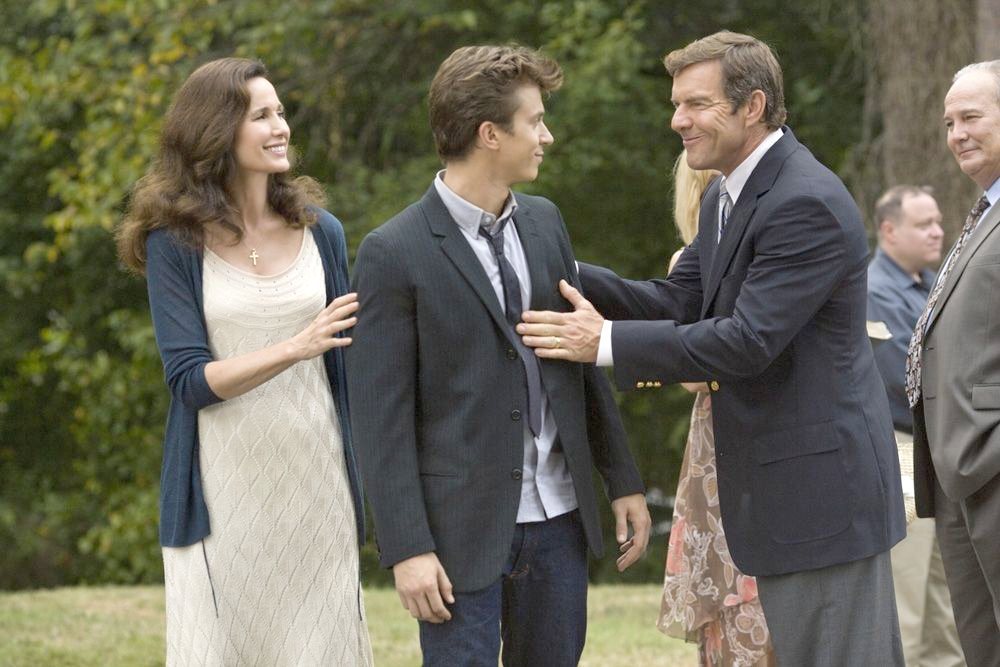
Boston teen Ren McCormack (Kenny Wormold) arrives in Bomont, Georgia after the death of his mom. Ren finds that Bomont banned dancing and loud music after the death of local teens, including the son of Reverend Shaw Moore (Dennis Quaid). Ren befriends goofball Willard (Miles Teller) and catches the eye of Ariel (Julianne Hough), Moore's wayward daughter. Ren decides to stand up for the right to boogie down and work for the ban's repeal.
Footloose retains the original's plot, set pieces and even a lot of the music. If anything the movie is too faithful to the original: Ren's "anger dance" is equally dumb scored to hip hop. But writer-director Craig Brewer does a good job making the film half-way credible. The film's Bomont is a believable small town, helped by good dialogue and well-cast minor parts. The country music and Southern atmosphere are certainly more appropriate than the original's pop tunes. For the most part, the updates and alterations help the film.

Brewer (co-writing with the original's Dean Pitchford) scores with a measured approach to the material. Ren's character is better fleshed-out, given a more concrete motivation for his quest. His schoolmates are played less broadly than the original, where they bordered on stereotype. Brewer's knack for dialogue and character interaction sells the drama. Sure it evaporates during the bus races (?) and breakdancing, but it's welcome while it lasts.
The old Footloose's biggest asset was the soundtrack, one area the remake is lacking. Kenny Loggins' title track and Deniece Williams' Let's Hear it for the Boy find their way into the story, along with new arrangements of Holding Out for a Hero and Almost Paradise. The original music, mixing rap and country music, is mostly disposable, though the well-choreographed dance scenes make up for a lot.
The teen cast is excellent. Kenny Wormold makes a very likeable lead, handling the dramatic moments as well as Kevin Bacon and the dancing sans stunt double. Miles Teller steals every scene as a memorably goofy Willard. Ziah Colon, Ser'Darius Blain and Patrick John Flueger compare favorably to their '84 counterparts. The only weak link is Julianne Hough, who's at least more palatable than the obnoxious Lori Singer.
The adults are less successful. Dennis Quaid underplays Moore to an excessive degree, rarely allowing emotion to show through. John Lithgow was more complex and likeable while Quaid seems constipated. Andie McDowell lacks Dianne Wiest's quiet intensity and anguished longing. Ray McKinnon picks up some of the slack with a warm, humorous performance as Ren's uncle.
Footloose (2011) is no masterpiece, but then neither was the original. The story is just as silly, but this time around we can take the scenes between the dance numbers a bit more seriously.
Saturday, March 6, 2010
Footloose

Footloose (1984) is one of the iconic cheesy '80s movies, and I'd rather review it than an R.W. Fassbinder movie just about now. The only reason I have any interest in it is my high school's musical production of it, and I am painfully susceptible to nostalgia. A rewatch the other day reminded me that Footloose is surprisingly good - cheesy and unintentionally funny, sure, but neither is it a bad movie as some would you have you believe.
Ren McCormack (Kevin Bacon) is a big-city kid who moves to the hick town of Bomont after his dad leaves home. He immediately butts heads with Reverend Moore (John Lithgow), who has helped pass a law outlawing dancing and rock music after the death of his son in a car wreck. After being targetted by a gang of local bullies, Ren enlists the help of feisty preacher's daughter Ariel (Lori Singer) and other townspeople to overturn the old law and make Bomont a fun place to live again.
Footloose's charms are very slight but undeniable. Surprisingly, the serious dramatic parts of the movie, particularly the tensions within the Moore family, hold up well, though they occasionally seem out-of-place in a movie with Kevin Bacon doing gymnastics around a grain mill. The main plot isn't implausible per se - it was loosely based on a true story, after all - but it's presented like a low-rent redneck Rebel Without a Cause: the tractor chicken scene being a dubious "highlight". The character interaction, and of course the music, is more enjoyable than the story anyway.
Herbert Ross's direction is perfectly competent, although the film often seems like a half-edited music video. The music is full of excellent pop pieces, many of which -Kenny Loggins's eponymous song, Deniece Williams's Let's Hear it For the Boy, Bonnie Tyler's Holding Out for a Hero - have become standards. The exception being the vomit-inducing Almost Paradise, which makes me want to throw a brick at someone's skull, but God knows I've listened to the soundtrack enough without having to subject myself to it.
Kevin Bacon gives an instant star turn; this isn't his first role (bit parts in Animal House and Friday the 13th) but he really shines here. Bacon really is a fine actor and overcomes the ridiculous aspects of his character to deliver genuine emotion and motivation. John Lithgow gives an excellent straight performance, making the Reverend a layered, sympathetic character, and Dianne Wiest contributes nicely around the edges. It's also amusing to see Chris Penn and Sarah Jessica Parker in early roles. The only blip is the obnoxious and wooden Lori Singer, who thankfully would mostly give up acting after this.
There's something to be said for nostalgia, and Footloose delivers in spades. Embrace the cheesy plot, silly '80s fashions and goofball music video scenes, and you have an enjoyable enough little film. Oh, and everybody cut footloose.
Saturday, December 19, 2009
Transformers: Revenge of the Fallen

God, where to start?
I don't see much reason to bother with a cogent review, since it's been picked clean by snarkers and critics since its release. I was expecting the movie to suck, but no way I could have expected .
The original was passibly watchable drek, even if it was essentially the wet dream of an especially nerdy 13-year old. This movie, if we can even call it that, is the wet dream of a six year old geek who still plays with his Transformers toys. It's a two-and-a-half hour toy commercial/Army recruitment video/barrage of bizarre stereotypes, racist and otherwise, without a single redeeming feature.
This isn't the most original way of going about this, but this film does not deserve a coherent review, merely an angry rant.
Twenty-Five Reasons Why Transformers 2 Blows:
25. It's two and a half hours long.
24. I spilled hot chocolate on my groin while watching it.
23. Ditzy mom on pot brownies.
22. The "Egypt" scenes are filmed in Wadi Rumm, Jordan (see below). From there, they have to go to Jordan. So they're filming in Jordan pretending they're in Egypt but have to go to Jordan. Thanks for completely fucking up my sense of geography.
21. Michael Bay's Epic Swooshy Camera. If I see one more "epic" spinning helicopter shot of badly-rendered computer-generated robots punching each other while Megan Fox's cleavage wiggles in the shockwave of an explosion, I will hunt you down and kill you.
20. Bumblebee, quit spewing random soundbytes at me. It ceased being funny the first time you did it in the first movie.
19. Gay dogs.
18. John Turturro's black assistant butcher with the huge gaped-teeth. Starting to sense a pattern here.
17. That random shot of a Decepitcon ripping an American flag off a bridge in New York City. What.
16. The Decepticons discussing how they should no longer hide themselves while standing on top of a New York skyscraper in full view of everyone with a pair of functioning eyeballs.
15. The point-of-view shot of the Allspark fragment burrowing through a table and the floor. Which is repeated with variations at least a dozen times in the movie. Who thinks this is cool anymore, forchrissakes!?!
14. "Let's see what's on your mind!" Said as the Decepticons are searching for something implanted in Sam's brain. Ahahahahahahahahahahahahahahahahahahahahahahahahahahahahahahahahahahahahahahahaha!!!!! Funny.
13. Characters from the first movie (the two soldiers, John Turturro) being brought back for little or no reason. Plus Sam's annoying and pointless room mate. Which brings us nicely to...
12. John Turturro's asscheeks. My God, the pain!
11. I know the US has arguably violated international law in invading Iraq, but don't you think China, Egypt and Jordan might have something to say about our deploying heavily-armed special to wage warfare in downtown Shanghai, around the Great Pyramids, or in the ruins at Petra? Oh well, why spoil the beauty of the thing with legality?
10. Transforming skank robot/rip-off of Terminator 3. Remember when I mentioned it being a six year old's wet dream? Yeah.
9. A depiction of college life that makes Animal House look like a documentary. The dance I went to first weekend of freshman year was in a little room with a leopard skin curtain, a few flashy lights, a stereo and twenty people. Here, the freshman intro dance has hundreds of people in a heavily-ornamented room having an amazing degree of fun as if this were a senior prom. Plus college skanks throw themselves on nerd's laps and try to seduce them. Damn, I knew there was a reason me and Liz broke up!
8. Little robots, be they the little hacker things, the one that burrowed into Shia LaBeouf's brain, Mosquitobots or robots voiced by Tom Kenny in a bad Joe Pesci impression that hump Megan Fox's leg, are extremely annoying.
7. Optimus Prime and Sam coming back from the dead within five minutes of each other. Jesus Christ movie, could you insult my intelligence any more? Oh yeah - you can also have "What you're looking for was inside you all the time!" bullshit thrown in for good measure.
6. Megan Fox, the world's biggest skank. And no, she's not hot either.
5. The racist Negrobots who do nothing except Step'n'fetchit-level race jokes and slightly damage one of the Decepticons. The worst part is that these guys are supposed to be "elite" fighters brought to Earth specifically to fight Decepticons. Or to provide comic relief for the mentally atrophied.
4. Shia LaBeouf, making a conscious career-decision to act like a nerdy chimp on crack instead of nurturing his acting talent to a reasonable degree.
3. No one who ever lived on Earth ever talked like anyone in a Transformers film, be it the obnoxious parents or Shia LaBeouf's stumbling-yet-witty nerd or the whacked-out superfluous room mate character or John Turturro. Period.
2. The basic premise of the movie. "Based on Hasbro's Series of Action Figures" indicates we're not watching Citizen Kane, but it also indicates where this movie went wrong. It's computer-generated robots wrestling with each other, with an occasional scene of poor excuses for "human beings" allegedly interacting. You can't get me that interested in watching blatantly fake pixels fight each other. Least of all for two-and-a-half hours.
1. Using Wadi Rumm as a prominent location. This means that I can never watch Lawrence of Arabia again without thinking of giant robot testicles.
Hell, I can never watch a film again without thinking of John Turturro's asscheeks.
Thank you, Michael Bay.
And there you have it! Move over, Batman and Robin and Howard the Duck, you've got company!
Tuesday, September 29, 2009
O

Since I haven't had much movie-watching time of late, here's another review from the IMDB comment archives. Hopefully my first Pitt News review is forthcoming, sooner rather than later. Until then (or my next free two hours for film watching)...
Odin James (Mekhi Phifer) is the only black student at Palmetto Grove, a private school in the Deep South. He is the star of the basketball team, is dating Desi (Julia Stiles) daughter of the school's dean, and is loved by teachers, coaches, and students. All that is, except Hugo (Josh Hartnett), the insanely jealous son of the basketball coach (Martin Sheen). Enlisting the help of hopeless outcast Rodger (Elden Hanson) and his girlfriend Emily (Rain Phoenix), Hugo launches a convoluted scheme to destroy Odin's life, convincing him that Desi is cheating on him and also turning him against best friend Mike Cassio (Andrew Keegan). Odin's jealousy eventually gets the better of him, and a tragic conclusion becomes inevitable.
Adapting Shakespeare for teens is a process that generally strikes me as intellectual masturbation or pompous self-importance. The themes of Shakespeare's plays are so universal and more importantly oft-copied that claiming descent from Shakespeare seems like a desperate attempt to add class to an otherwise typical film. Luhrman's Romeo+Juliet was a loud, flashy mess, redeemed only by its lead actors. Ten Things I Hate About You and She's the Man were disposable fun but more or less interchangeable with any number of other teen flicks, and in any case bearing only tertiary relation with their source material. I'm not impressed with She's the Man claiming descent from Twelfth Night because its basic story has been done five million times since.
However, O stands above these films, despite a few notable flaws, namely the ending. Tim Blake Nelson adapts what is (in my opinion) Shakespeare's greatest tragedy Othello into a modern setting with surprising skill, keeping the spirit and themes of the play intact and even adding additional layers to it.
Shakespeare's play is as much about the villainous Iago as it Othello. Despite his wickedness, Iago is a sympathetic character; he is clearly a tormented man with inner demons he doesn't know how to face. In this film, Hugo has additional motivation beyond merely being passed over for promotion (or acknowledgment as MVP). His father barely acknowledges his existence, while embracing Odin as "the son I never had". As despicable as Hugo's actions are, it's easy to see what would drive him to such extremes.
Also added is an exploration high school caste system. Usually dealt with in a truncated and comic fashion, it is devastatingly portrayed here. Rodger, Hugo's accomplice, is the son of one of the school's contributors, but also a geek who is beat up and picked on by pretty much everyone. There is a painful scene where Cassio torments him at a basketball game until he leaves. Hugo's alienation from his team mates is also a major factor, and it's easy to see why many people thought of Columbine when the film was released. People cast out by society are likely to their revenge, and this film shows that with devastating effect.
Perhaps inevitably, the movie gives more weight to Odin's race than the source material did. The film features several sex scenes, including a disturbing one at mid-point where Odin's jealous begins to take hold in the middle of coitus - a scene that is both disturbing and effective. Odin is a model student, a great player, and liked by almost everyone in spite of his race, and yet as Hugo's scheme begins he begins reverting to stereotypes - he does drugs, is violent and moody, and at the end is driven to murderous rage. Odin is a victim as much of his own demons as Hugo, and the movie does an excellent job showing that.
The biggest problem with the film is the end. Although abbreviated, the movie does a good job following the original text, and the film is perfectly paced. Until the climax. The decision to reduce the last two acts into a brief montage scene was a mistake, and ruined the pacing of the film. Odin's monologue at the end justifying his actions would have been more powerful if the movie hadn't just leaped into it.
The cast is uniformly solid. Mekhi Phifer is powerful as Odin; his portrayal of Odin as a victim of his own insecurities is spot-on, and he is a thoroughly believable character throughout. Josh Hartnett, whom I've never rated as much of an actor, surprised me with a powerful performance as the treacherous Hugo. Julia Stiles' part as Desi is underwritten but Stiles cannot be faulted for that, and as always her performance is top-notch. Andrew Keegan, Rain Phoenix, and Elden Hanson also create memorable characters. Martin Sheen and John Heard are effective as the two most prominent adult cast members.
Despite the rushed and flawed ending, O is definitely the best of the teen adaptations of Shakespeare. The spirit of the original play is kept intact, and the characters are adapted well into a modern context. Definitely worth a look.
Sunday, March 1, 2009
Mean Girls

Having nothing but a few rewatches this week (Slumdog Millionaire and The Nun's Story), I'll turn back the clock to two Wednesday's ago and review Mean Girls. We had to watch this film for, of all things, the Emerging Leaders program to study different types of power and leadership (oh, BROTHER). It about lived up to my expectations, which is that it's the same banal, overly clever and not very satisfying teen movie that we've all seen five million times before. The praise doled out to this is from certain corners is baffling - indeed, almost as baffling as that damned Juno. But at least Mean Girls didn't get a slew of Oscar nominations, so it's less offensive in this regard.
There are very, very few teen-oriented movies that I genuinely like; in fact I can't think of one that I do. I might have a small degree of affection for something like Footloose or Ten Things I Hate About You but there tend to be mitigating circumstances, be it nostalgia or otherwise, for such opinions. Maybe it's because I was an outsider who flitted in and out of the various "cliques" and social groups that Hollywood insists exists, but I've never found much any Hollywood or TV portrayal of high school and its various inner workings to be even remotely accurate, perhaps because most such films are written and directed by out of touch fifty year old Hollywood producers.
Such is the case with Mean Girls. For all its alleged posturing as a hip, funny (what?) and insightful view of high school cliquery (?), it's really the same exact film as everything from Clueless to Breakfast Club to Ten Things I Hate About You to She's All That repackaged in a snarky bundle. Granted, I never possessed a vagina, but I think I have a decent idea of how high school works. Clearly, however, Hollywood does not.
The film's plot involves Cady Heron (Lindsay Lohan), a teen who has spent most of her life abroad in Africa with her scientist parents. She arrives at a regular high school and finds it completely baffling. She soon finds some friends in outcasts Janice (Lizzy Kaplan) and Damian (Daniel Franzese), but soon becomes fascinated by the "plastics", a group of ultra-cool girls led by the nasty Regina (Rachel McAdams) who are worshipped by everyone for their perfect looks, fashion sense - and their control of gossip and other secrets which would doom the student body. At Janice's urging, Cady infiltrates the Plastics and begins to undermine them, only to find herself becoming exactly like them.
The film adheres almost slavishly to the confines of its genre. New girl struggling to fit in? Check. Introduction to all of the different arbitrary cliques of the school (which I swear to God happens in every one of these movies)? Yessir. Blatantly artificial and obnoxious "witty" dialogue a la Diablo Cody? You bet your ass. Likeable if obnoxious nerdy kids? Yep. Quirky but largely ineffectual adults? Check, and then some, although Tim Meadows' flustered principal and Amy Poehler's hopelessly out-of-it "cool mom" get many of the film's best moments. So all that's in place, plus its share of gross-out, sexual and pratfall humor that belie any claims of wit, as well as the usual cartoonish hyperbole that makes the film as realistic as Star Wars. When the student body degenerates into outright warfare over the publication of Regina's diary, you know the film has lost it; even the film of Harriet the Spy didn't go THAT far. The movie doesn't even address the hell of being different or social in any meaningful way; Cady goes almost immediately from outcast new kid to cool in-girl to outcast everyone hates, with no room in between.
It's a pity, as the movie does have a few ideas that (almost) make it work. The characterization of Cady, at least in the early going, is an interesting wrinkle that the film deserves credit for. Her descent into Plasticity is well-written and a creditable bit of character development by screenwriter Tina Fey. (The use of Lizzy Kaplan's damaged and vengeful Janice character, as the tool who brings about Cady's transformation, is quite clever as well.) But then the movie ruins it with her cartoonishly-depicted fall, her predictable "redemption" and obnoxiously overwrought "I've learned the error of my ways!" speech at the prom. (Yes, the movie ends at a prom. So does every teen movie on Earth, you know.) The movie may try to snark its way around it, but the fact remains that it squanders its good idea for the sake of the usual cliche "We all dance happily together" conclusion that makes me wretch. This movie doesn't have bite, it has saccharine gumming, and it skips out completely on its potential.
The actors do creditable work. Lindsay Lohan does a nice job with Cady's inner turmoil and character development. Of the evil "plastics", Lacey Chabert's clueless and sexy Gretchen is by far the most enjoyable to watch, though Rachel McAdams is the typical bitch queen you'd expect from this sort of film. I do also like Lizzy Caplan's turn as Cady's emotionally damaged friend Janice, though Daniel Franzese's gay caricature is just annoying. The adult performances of Tina Fey, Tim Meadows and Amy Poehler contribute nicely around the edges.
I guess I'll admit that I'm being unfair to the extent that I'm judging such a film due to realism/plausibility. But I'm also judging it for entertainment value, and there's precious little of that here, too. If you're in the target audience, the musings of a pompous, stuck-up wannabe film buff like myself won't much matter. For the rest of us, though, Mean Girls is yet another mediocre entry in the "What Hollywood thinks of teens" genre - and doesn't even begin to get right.
Rating: 5/10 - Mediocre
Subscribe to:
Posts (Atom)