Showing posts with label Musicals. Show all posts

Sunday, April 21, 2013

The Dregs of 2012: Rock of Ages and Savages

Last week I ripped into Snow White and the Huntsman, a paragon of Hollywood's brain dead blockbuster mentality. Well, that film's aggressive mediocrity suddenly seems refreshing. Courtesy of HBO, I viewed Rock of Ages and Savages this weekend, two excretions that redefine awful. If 2012 produced worse movies, please keep them to yourselves.

Rock of Ages (2012, Adam Shankman)
That Rock of Ages sucked was a given; musicals conceived on the same principle as KBox's '80s night don't leave much room for quality. But I wasn't prepared for how aggressively obnoxious it is. This movie spews venomous contempt for its audience, assuming nostalgists would flock to see Foreigner and Pat Benatar mangled by miscast stars. Thankfully, its poor box office proved it wrong.

Oklahoma ingenue Sherri Christian (Julianne Hough) arrives in Hollywood hoping to find music stardom. She lands a job at The Bourbon, a rock hotspot run by Dennis and Lonny (Alec Baldwin and Russell Brand), and falls for bar back Drew (Diego Boneta). Drew gets his big break opening for rocker Stacee Jaxx (Tom Cruise), but after Drew thinks Sherri slept with Stacee he dumps her, falling under the spell of cynical agent (Paul Giamatti). Sherri starts working as a stripper; Drew fronts a boy band. Somehow factoring in is Patricia Whitmore (Catherine Zeta-Jones), devoutly conservative wife of Los Angeles' Mayor (Bryan Cranston), who nurses a grudge against Stacee.

Rock of Ages is crassly cynical, an endless parade of '80s hits randomly assembled, plot and characters an afterthought. The shallow romance is crossed with inexplicable plot twists; Drew dumps Sherri over a misunderstanding, so of course Sherri becomes a pole dancer. Drew sells out in a painfully contrived arc, while Patricia's villainous machinations go nowhere and amount to nothing. The cast sings and dances well, but without characters to play it's for naught. Maybe onstage it's a blast; the movie's a torture session.

The songs are the main attraction, making their bizarre presentation all the more inexplicable. "Waiting for a Girl Like You" becomes a mawkish duet; Patricia performs "Hit Me With Your Best Shot" juxtaposed with her husband getting spanked (!!!); Sherri's boss (Mary J. Blige) uses "Anyway You Want It" to extoll the virtues of stripping; Stacee Jaxx belts outs "I Want To Know What Love Is" while boinking a Rolling Stone reporter (Malin Akerman). And can we please have a moratorium on "Don't Stop Believin'?" Journey's mawkish ballad sucked to begin with; Glee kicked it to death. Its presentation as a heartfelt love song makes a powerful purgative.

Julianne Hough (Footloose) and Diego Boneta are hopeless; Hough can at least sing, but neither can out-act an Old Navy mannequin. Tom Cruise received inexplicable praise for his extended cameo; he's his usual cocky twat, except drunk. Alec Baldwin and Russell Brand get the movie's one funny moment, coming out to "I Can't Fight This Feeling." Catherine Zeta-Jones is just awful, while Paul Giamatti, Mary J. Blige, Malin Akerman and Bryan Cranston flounder about haplessly. With this cast, Rock of Ages must have been fun to make; too bad that's not conveyed to the audience.

Savages (2012, Oliver Stone)
This brings us to Savages, the latest failure from Oliver Stone. Far removed from his Maestro of Excess days, Stone has produced 17 years of movies overwrought (Natural Born Killers), overreaching (Alexander), banal (World Trade Center) and baffling (W.). Here Stone injects a straight genre flick with overdoses of pretension and overbearing style. It isn't pretty.

A trio of Laguna Beach slackers run a lucrative marijuana business. Chon (Taylor Kitsch) is a mentally-scarred Army veteran; Ben (Aaron Johnson) a stoner surfer; O (Blake Lively) is a rich girl who loves them both. Things get hairy when Mexican kingpin Lado (Benicio Del Torro) contacts them with an enticing offer. This leads to a series of double crosses, kidnapping and shootouts, with Lado's wife (Salma Hayek) and a crooked DEA Agent (John Travolta) further mucking things up.

Remember my reviews of Hanna and Prophecy, where I ragged on auteurs helming genre movies? Here's Exhibit C. Stone returns to the jerky photography and feverish editing that made JFK and Nixon unique, but it only makes Savages incoherent. It's a slack-witted collection of shootouts, decapitations and rape scenes posturing as character study. Our heroes are friendly drug dealers who just want to screw and, like, invent renewable energy and stuff. After a long, bloody denouement, there's a twist more insulting than "It was all a dream." What a brilliant head fake! Bertolt Brecht's got nothing on you, Oliver.

Don't worry, the brilliance isn't confined to the ending. Writers Stone, Shane Salerno and Don Winslow supply dialogue befitting a Steven Seagal flick. "I had orgasms," O narrates a love scene with Chon; "he had wargasms." Whoa. Even better: "Ben was basically Buddhist... Chon was basically a Baddist." That's deep, man. Deeper still are Stone's potshots at Wall Street and the War on Drugs, deeming America "a nation of whores." Apparently this parade of sadistic violence, inept photography and brain-dead plotting is a statement, Stone's Traffic maybe. Both feature drugs, oft-kilter colors and Benicio Del Torro, right?

Taylor Kitsch ruined his shot at stardom with three massive flops in 2012: between this, Battleship and John Carter, he's forfeited any goodwill from TV's Friday Night Lights. Good riddance, as he makes Julianne Hough look like Maggie Smith. Aaron Johnson (Kick-Ass) isn't much better; the talented Blake Lively (The Town) can't overcome the godawful script. Benicio Del Torro and Salma Hayek fare better, playing their villains this side of burlesque. John Travolta shows up long enough to ruin several scenes.

* * *

What wonders does the 2013 summer movie season have in store? Stay tuned to find out!

Wednesday, April 17, 2013

Carousel

After the massive success of Oklahoma! (1955), Fox re-teamed Gordon McRae and Shirley Jones for another Rodgers and Hammerstein musical. Carousel (1956) is an excellent stage show hampered by indifferent filmic staging; fortunately, the source material is good enough to shine through.

At a New England carnival, young Julie Jordan (Shirley Jones) meets fast-talking carousel barker Billy Bigelow (Gordon McRae). Even after being warned of Billy's lecherous ways Julie falls for him. The two marry but endure a rocky marriage, with Billy sponging off Julie's Cousin Nettie (Claramae Turner) instead of working. After Julie becomes pregnant, Billy joins with two-bit hood Jigger (Cameron Mitchell) in a botched robbery. Billy dies, returning to earth 15 years later to help his daughter (Susan Luckey) avoid a similar fate.

It's obvious why Carousel isn't listed among the great screen musicals. Henry King's static direction lacks the skill of his Westerns like The Gunfighter, rarely expanding beyond lazy master shots. Even the choreography rarely transcends competence, save the marvelous, wordless "Carousel Waltz" opening. The awkward mixture of seaside exteriors and hokey sets don't help either. Despite beautiful Cinemascope photography it doesn't even begin to approach the visual dynamism of Singin' in the Rain and My Fair Lady.

But Carousel transcends its mediocre staging. Rodgers and Hammerstein produced some of their most beautiful songs for this show, wonderful compositions that will appeal even to non-musical fans. Besides the aforementioned "Carousel Waltz," the best numbers are the simplest staged. Billy gets the lovely "Soliloquy," musing proudly over his unborn child, which redeems what's been a lousy character. The big showstopper is "You'll Never Walk Alone," sung as a heartrending solo by Claramae Turner. These wonderful songs alone make Carousel worthwhile.

Carousel is a loose adaptation of Liliom, Ferenc Molnar's fantasy of Heavenly redemption made into a memorable Fritz Lang film. We wince at some of the dated assumptions about gender (maybe getting smacked around does hurt, Julie) but the attempts at crafting flawed musical protagonists are admirable. Less admirable is the moral espoused by "Stonecutters Cut It On Stone"; falling between good and bad shouldn't mean well-intentioned wife beater. But the charming story of love and redemption compensates for these mixed messages. Billy manages to overcome a rotten, aimless life, performing a simple act of charity that saves his daughter from oblivion.

Gordon McRae is good mixing masculine bluster with reluctant romanticism, making Billy's pathetic tragedy palpable. Shirley Jones makes a perfect match, sweetly naive, then bewildered by her husband and daughter. Cameron Mitchell gets a rare standout role as a loathsome heel; Barbara Ruick's Carrie makes a good match for Julie. Claramae Turner belts out the big number with aplomb and Susan Luckey is endearing in her brief appearance. Groggy favorite Gene Lockhart (Hangmen Also Die!) contributes a minor role.

Carousel is an enjoyable show. There are plenty of great songs on offer, which help overcome its underwhelming presentation.

Saturday, April 13, 2013

Saturday Night Fever

Saturday Night Fever (1977) is one of those movies that's so iconic, it's impossible to approach it fresh. John Badham's film was an astonishing smash hit, grossing $282,000,000 on a $3,000,000 budget, catapulted John Travolta to stardom and provided a definitive, oft-parodied portrait of the disco phenomenon. The real strengths lie in its story, which deconstructs the very culture it purports to celebrate.

Tony Manero (John Travolta) is a 19 year old New Yorker living with his parents (Val Bisoglio and Julie Bovasso), working as a paint store clerk and hanging out with several low-life toughs. By night Tony's an accomplished disco dancer, using his skills to bed women and bolster his self-confidence. Tony's life changes when he meets Stephanie (Karen Lynn Gormley), a tough-minded professional who resists his advances. Tony enlists Stephanie to partner with him, struggling with his mixture of affection towards her and alienation from his friends and family.

Few films so defined a decade as Saturday Night Fever. Based on a largely fictionalized New York Magazine article by Nik Cohn, Fever popularized the gaudy fashions, underlit nightclubs and dancing previously associated with British Mod culture or gay nightclubs. The dance sequences remain impressive, with John Travolta's effortless performance backed by the Bee Gees' excellent soundtrack. Even those immune to disco's kitsch charm will enjoy Travolta strutting his stuff.

Beneath the gaudy glitz lies an incisive character study. Norman Wexler's script brutally dissects the male chauvinist '70s, where girls are nothing more than a quickie in the back of a car. This attitude's brutally exemplified with Annette (Donna Pescow), Tony's admirer whose hanging on reaps tragic consequences. Tony's friend Bobby C (Barry Miller) impregnates his Catholic girlfriend, leaving him in a dilemma. Even Stephanie is shown having to sleep with a coworker to get ahead. Tony's crew are classless, alienated thugs; when not dancing or screwing they're picking fights with Puerto Rican street gangs or performing reckless stunts on the Verrazano Narrows bridge. It's hard to generate much sympathy for these vulgar lowlifes. 

Fortunately, Tony is plenty sympathetic. He's as disaffected as the hero of a British kitchen sink drama, with a lousy job, cranky parents and a priest brother (Martin Shakar) with doubts about his faith. Elements of his characterization recall Rocky, the inarticulate Italian-American who finds recreational skill, but Tony's much more likeable. Stephanie's guidance brings out his hidden depths: he impresses Stephanie with knowledge about the bridge, showing an ambitious young man with potential for growth. He loses pleasure in dancing after winning a "rigged" contest against extremely talented Puerto Ricans and stops objectifying women after making a crude pass at Stephanie. Jettisoning his childish attributes, Tony makes a connection with Stephanie that's genuinely moving.

John Travolta has endured an erratic career, mixing hits like Grease and Pulp Fiction with megaton bombs (Battlefield Earth anyone?). '70s audiences would have known him from TV's Welcome Back, Kotter but this entirely different levels. Travolta transcends his smiling charmer persona, making Tony likeable but coarse, confused and frustrated. It's a layered turn from an actor who, to be kind, is rarely subtle.

Karen Lynn Gormely does a nice job as Stephanie, making her a likeable "modern woman" who has to sacrifice to get ahead. Yet it's Donna Pescow's turn as the pathetic Annette who steals the show. Martin Shakar gets some meaty scenes as Frank's conflicted brother. Of Tony's pals, Barry Miller's tragic Bobby C makes the strongest impression.

Saturday Night Fever is a genuinely solid drama. Outward appearances aside, it's unfair to label this as a glitzy relic of the disco era, no different from Xanadu or Can't Stop the Music. There's a reason it's still watched 36 years later.

Friday, January 11, 2013

Les Miserables

There are moments in Tom Hooper's Les Miserables (2012) that achieve genuine pathos. Here a colorful supporting turn, there a genuinely affecting ballad, a flash or two of genuine spectacle. But ultimately, Les Mis's highlights are weighed down by insufferable pomposity.

Jean Valjean (Hugh Jackman), imprisoned for stealing a loaf of bread, skips out on parole in 1815 France. He reinvents himself as M. Le Mer, Mayor of a small town, but keeps crossing paths with Inspector Javert (Russell Crowe), his old tormentor. Valjean raises Cosette (Amanda Seyfried), the orphaned daughter of misbegotten Fantine (Anne Hathaway). In 1832 Paris, Cosette falls for Marius (Eddie Redmayne), member of the ABC Club of student revolutionaries. Everyone grows entangled in a failed student uprising, which leads to bloodshed but leaves nothing resolved.

In its stage incarnation, Les Miserables has been pleasing audiences worldwide since 1980. On the basis of the film, it speaks little of theatergoers' taste. Victor Hugo's dense, intricate historical novel is boiled down to the crudest soap, replacing its social commentary and rich characters with overbaked melodrama. Perhaps the endless singing and naked, cloying emotionalism work better on stage. On film it makes for a tiresome 157 minutes.

The material's operatic approach is a major gripe. True, there are several show-stopping tunes on display. But the constant singing dulls their impact, investing even the most banalities with false grandeur. For every memorable song there's two clunkers. Worse, the big character numbers sound the same notes endlessly, without variation or development. After hearing Javert ponder his devotion to the law for the 40th time it loses impact.

This repetitive character non-development takes its toll, leaving its protagonists one-dimensional. Valjean's conversion from vengeful thief to honorable man is interesting in Hugo's novel. On film, he scrambles through plot points - here Valjean's a thief, now a Mayor, then a Paris recluse - without noticeably developing. Similarly, Javert's obsession with Valjean never achieves the required grandeur. He's not a tragic villain but a doltish brute. Young lovers Marius and Cosette are invested with soaring, tragic pathos that they haven't remotely earned.

The stars try their hardest. Hugh Jackman sings beautifully but can't do much with a thoroughly dull character. Russell Crowe on the other hand is utterly, inexplicably awful, performing all his songs in an inexplicable gruff whine. Eddie Redmayne (My Week With Marilyn) and Amanda Seyfried (Mean Girls) show admirable pluck inhabiting featherweight characters.

Les Mis's gems lurk in the corners. There's Anne Hathaway, truly heartbreaking for the 15 minutes she's onscreen. Her one-take, bravura performance of I Dreamed a Dream inspired a tear in even this cynical blogger. There's Sacha Baron Cohen and Helen Bonham Carter's hilarious doubles-act as Cosette's adoptive parents, performing the incomparable Master of the House. There are no-name supporting players like Samantha Barks and Aaron Tveit who steal their scenes. However limited their screen-time, these characters provide sorely needed life.

But even they can't overcome Tom Hooper's awful direction. Never mind Hooper's anemic staging of conventional set pieces: 20 students standing on broken chairs isn't a revolution, it's a frat party. The musical numbers are endless close-ups, no matter how dramatic or colorful the song, complete with his trademark egregious angling and baroque framing. In John Adams and The King's Speech it's merely an irritating quirk; here it's a deal breaker. Isn't one of the pleasures of a musical spectacle? Why all the rich costumes and expensive sets if we're staring endlessly at Russell Crowe's atonal maw? Would it kill Hooper to hire a choreographer for some real dance numbers?

In short, Les Miserables stinks. And at two-and-a-half interminable hours, the smell grows unbearable.

Saturday, July 7, 2012

Expresso Bongo

In 1958, Julian More and Wolf Mankowitz teamed up on the musical Expresso Bongo. Starring Paul Scofield, Millicent Martin and James Kenney, it explored the seedy side of the English music industry. Its mixture of caustic satire and witty music proved a smash hit, outperforming even My Fair Lady's contemporaneous run.

A year later, Mankowitz helped director Val Guest (The Quatermass Xperiment) bring Expresso Bongo to the screen. With singer Cliff Richard cast as musician Bert, the movie smoothed over the play's rougher edges, removing most of the songs and making Bert more likeable. Regardless, much of the nastiness shines through, largely through Laurence Harvey's energetic turn.

Johnny Jackson (Laurence Harvey) is a hard-luck agent reluctant to promote his minimally-talented girlfriend (Sylvia Sim). Spotting Bert Rudge (Cliff Richard) performing in a coffee shop, Johnny gets an idea. Through Johnny's tireless promotion, "Bongo Herbert" becomes London's next big thing. However, Bert starts to chafe at his unequal contract, which easily benefits Johnny more than him. After a liaison with feisty American actress Dixie Collins (Yolande Donlan), Bert decides to cut loose of Johnny.

Expresso Bongo captures London just before Beatlemania and the '60s mod scene exploded. The London night life pops with all kinds of attractions, from seedy stripteases and coffee joints to glamorous night clubs. Stardom is a lucky turn away, with bobbysoxers and the media looking for the next big thing. Mankowitz's script retains its razor-edge, with bristling bandinage and some surprising profanity. Guest's spirited direction provides the right atmosphere of swinging seediness, making use of long-takes and expressive cinematography.

Even bowdlerized, Bongo's depiction of the music industry isn't pretty. Johnny is absolutely shameless in advancing himself. He fast-talks producers, appears on TV and moulds Bert's image on a whim ("You know what's missing... religion!"). Even his contract isn't strictly legal. Bert's character suffers: in the play he was a talentless schemer who proves even more wily than Johnny. His depiction here as a naive, unwitting star is more conventional but still effective. Johnny's finally routed by Dixie, whom he'd ironically used to advance Bert. Her learned cynicism makes mincemeat of Johnny's pretensions.

Laurence Harvey provides a manic, sleazy energy generally lacking in his screen performances. His Johnny's one of the great movie cads, whose charm and snappy dialogue mesh with his heartless ambition - a bastard you love to hate. Cliff Richard gives a blandly likeable performance that Ricky Nelson would approve of. His musical numbers are backed by his long-time band The Shadows. Fetching Sylvia Sims and dishy Yolande Donlan provide nice accompaniment.

Expresso Bongo is an entertainingly cynical romp through pre-Mod London. It's a fascinating time capsule that retains an off-beat, nasty charm.

Sunday, March 18, 2012

Footloose (2011)


People love complaining about remakes. For whatever reason they'll become irate whenever a new version of an old film or TV series is announced, wailing about Hollywood "running out of ideas" and "raping their childhood." The only thing surer to piss off moviegoers is another round of Star Wars revisions.

This is nonsense. For one, remakes have existed since the silent era. Masterpieces like The Wizard of Oz and The Maltese Falcon are remakes, after all. Second, they don't drive the original out of existence. Classics like Psycho and The Day of the Jackal stand tall long after the piss-poor updates vanish into the Best Buy bargain bin. This is doubly true of kitschy pop fads; anyone remember Fame (2009)? Of course you don't.

This mini-rant is a good intro to Footloose (2011). A remake of one of the silliest (yet most endearing) pieces of '80s cheese imaginable, it's been in gestation for ages. Back in high school I remember reading about an adaptation of the Broadway musical starring Zack Efron. This version sticks fairly close to the 1984 film, adding a modern twist to the music and characters. The result is much better than it should be.

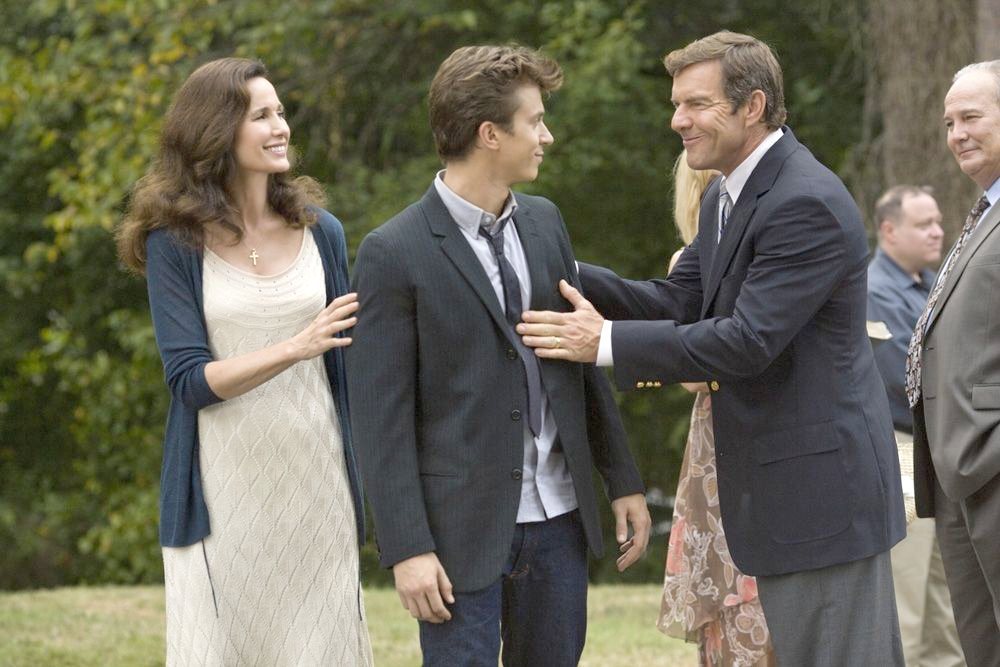
Boston teen Ren McCormack (Kenny Wormold) arrives in Bomont, Georgia after the death of his mom. Ren finds that Bomont banned dancing and loud music after the death of local teens, including the son of Reverend Shaw Moore (Dennis Quaid). Ren befriends goofball Willard (Miles Teller) and catches the eye of Ariel (Julianne Hough), Moore's wayward daughter. Ren decides to stand up for the right to boogie down and work for the ban's repeal.

Footloose retains the original's plot, set pieces and even a lot of the music. If anything the movie is too faithful to the original: Ren's "anger dance" is equally dumb scored to hip hop. But writer-director Craig Brewer does a good job making the film half-way credible. The film's Bomont is a believable small town, helped by good dialogue and well-cast minor parts. The country music and Southern atmosphere are certainly more appropriate than the original's pop tunes. For the most part, the updates and alterations help the film.


Brewer (co-writing with the original's Dean Pitchford) scores with a measured approach to the material. Ren's character is better fleshed-out, given a more concrete motivation for his quest. His schoolmates are played less broadly than the original, where they bordered on stereotype. Brewer's knack for dialogue and character interaction sells the drama. Sure it evaporates during the bus races (?) and breakdancing, but it's welcome while it lasts.

The old Footloose's biggest asset was the soundtrack, one area the remake is lacking. Kenny Loggins' title track and Deniece Williams' Let's Hear it for the Boy find their way into the story, along with new arrangements of Holding Out for a Hero and Almost Paradise. The original music, mixing rap and country music, is mostly disposable, though the well-choreographed dance scenes make up for a lot.

The teen cast is excellent. Kenny Wormold makes a very likeable lead, handling the dramatic moments as well as Kevin Bacon and the dancing sans stunt double. Miles Teller steals every scene as a memorably goofy Willard. Ziah Colon, Ser'Darius Blain and Patrick John Flueger compare favorably to their '84 counterparts. The only weak link is Julianne Hough, who's at least more palatable than the obnoxious Lori Singer.

The adults are less successful. Dennis Quaid underplays Moore to an excessive degree, rarely allowing emotion to show through. John Lithgow was more complex and likeable while Quaid seems constipated. Andie McDowell lacks Dianne Wiest's quiet intensity and anguished longing. Ray McKinnon picks up some of the slack with a warm, humorous performance as Ren's uncle.

Footloose (2011) is no masterpiece, but then neither was the original. The story is just as silly, but this time around we can take the scenes between the dance numbers a bit more seriously.

Monday, April 4, 2011

Oh! What a Lovely War


Richard Attenborough's debut film is an interesting experiment, if not an entirely successful one. Think Blackadder Goes Forth with musical numbers and an all-star cast, and you're not too far off.

How to try and describe the plot? World War I is presented as a series of musical numbers and baroque sketches, mostly focusing on the extended Smith family, who ultimately sends four sons to fight in the war. While the soldiers suffer and die in the trenches of France, the officers party and scheme for personal glory, the aristocrats bemoan downturns in business, and the civilians wonder what it's all about.

Based on a much-beloved stage musical, Oh! What a Lovely War is an odd film that's very much of its time. Tony Richardson's Charge of the Light Brigade mixes its scornful condemnation of Victorian England with Richard Williams's satirical animation, and the wonderfully bizarre The Ruling Class crams its scathing social satire with slapstick goofiness and off-the-wall musical numbers. War follows suit, adapting WWI period tunes into a left-wing musical revue, to rather odd effect.

As a series of vignettes, Oh! What a Lovely War is decidedly hit-and-miss. The film remains close to its stage roots, with Attenborough opting for an oddly Expressionist film. There's heavy use of sets in dialogue scenes and musical numbers, but the film opens up for some impressive frontline footage. Attenborough uses stagey but effective devices to make his point: the scoreboard measuring yards gained to casualties, Brighton's West Pier as a symbol of the war's effect on British society, the merry-go-round of slaughtered French cavalrymen. For all this Brechtian hooey, the strongest scene is the most straightforward: a brief but affecting depiction of the Christmas Truce of 1914, when British and German troops put aside their differences for a moment of humanity. If you want to make a pacifist statement, you needn't go further than that.

Other ideas are less inspired. The opening with statesmen reciting historical speeches is long, dry and draggy, and the scenes of the military brass and aristocrats play as crude, overemphatic caricature. The arresting image of red poppies on the battlefield is repeated four or five times too many - not surprising given Attenborough's aversion to subtlety. The historical satire isn't particularly insightful or revealing: World War I is the obvious choice for an anti-war film and Attenborough doesn't make any points not already addressed in, say, Paths of Glory. Worst of all, the film never quite connects on a human level: the Smiths get lost in the shuffle of a truly enormous cast, and moments that ought to be affecting (namely the ending) don't really register.

War begins the Attenborough trend of enlisting a galaxy of British stars for cameos and bit parts. The opening scene alone features a gobsmacking array of talent: Ralph Richardson, John Gielgud, Kenneth More, Ian Holm, John Clemens and Jack Hawkins. John Mills, Laurence Olivier and Michael Redgrave play boneheaded Generals; Jean-Pierre Cassell plays a French cavalryman; Vanessa Redgrave appears as a fiery suffragette; Maggie Smith is a bawdy musical hall madam; Dirk Bogarde and Susannah York have about thirty seconds' screen time as snooty aristocrats. Attentive viewers can also spot Edward Fox (The Day of the Jackal), Corin Redgrave (A Man for All Seasons), Isabel Dean (A High Wind in Jamaica), Cecil Parker (The Ladykillers), Michael Bates (Patton), Maurice Roeves (Young Winston) and Gerald Sim (Ryan's Daughter). If you enjoy playing "spot the star," this is the film for you.

On the whole, Oh! What a Lovely War is an interesting film even if it isn't especially good. Buried underneath the excess and heavy-handed pacifist preaching are some good ideas and affecting images.

Thursday, January 20, 2011

Clint Eastwood to direct... A Star is Born!?!


If needed your mind blown by complete randomness today, this should suffice:

EXCLUSIVE: Clint Eastwood To Direct Beyoncé In Musical Of 'A Star Is Born'

By NIKKI FINKE | Thursday January 20, 2011 @ 3:46pm PST


This is a real shocker, and not just Hollywood but the rest of America should love it. What a coup for Warner Bros getting The Man. Of course, Clint Eastwood wiIl produce as well as direct the script by Will Fetters along with producers Billy Gerber and Jon Peters (who made the infamous 3rd version of A Star Is Born with Barbra Streisand and Kris Kristofferson). No male lead is cast yet, but the possibilities are endless. The project, which has been at WB for several years, had hoped to pair Beyoncé and Will Smith. But how about P Diddy (who's turning into a surprisingly fine actor along with Beyoncé's husband Jayz), Eddie Murphy (reteaming with Beyoncé after Dreamgirls), or any white guy imaginable though Robert Downey Jr and Jon Hamm are names that have been floating? Of course, Clint has had a huge interest in music on screen (remember him as a jazz DJ in Play Misty For Me?), directing Bird, doing all his own scores for his movies and even received an Avademy Award nomination for one of them. Then again, I'm one of thise huge fans who thinks Clint can do anything. And Beyoncé scored big at the box office in Sony/Screen Gems' Obsession. The idea is to start shooting in the Fall.

The idea of a 4th version of A Star Is Born has been floating around for some time now. Even this pic fell apart and just came back together. Back in January, Deadline repported that Nick Cassavetes was in early talks with Warner Bros to direct an updated version of the well-worn story of a love affair between an alcoholic star on the way down, and a young artist on the rise.

There have been a trio of A Star Is Born versions made since the 1930s, the last one coming in 1976 with Kris Kristofferson playing the boozy singer and Barbra Streisand the ingenue. Or even 4 if you consider What Price Hollywood (1932) made by George Cukor and is often forgotten since the film was remade successfully so many times.

Next: Michael Mann to helm a My Fair Lady remake starring Lady Gaga!

Saturday, July 10, 2010

Funny Face


I’ve noted already that I have no great love for musicals, and today’s subject is no exception. Funny Face is a bit of vacuous romantic fluff buoyed by some striking photography, an adorable Audrey Hepburn and old school musical star Fred Astaire doing what he does best. Otherwise, it’s utterly disposable.

Fashion photographer Dick Avery (Fred Astaire) tries to find an “intellectual” backdrop for a photo shoot with a ditzy magazine model, and ends up shooting in a bookshop where egghead Jo Stockton (Audrey Hepburn) works as a clerk. Dick comes up with a brilliant idea: using the decidedly different Jo as a fashion model for an upcoming Paris photo shoot! His boss, fashion tycoon Maggie Prescott (Kay Thompson) is enthralled with the idea, but Jo is reluctant; she’s only conned on the promise of meeting French philosopher Professor Flostre (Michel Auclair), and so our three protagonists jaunt off to Paris, with the inevitable entanglements of love and work and sight-seeing and disillusionment playing their part.

Funny Face is an odd musical. Its soundtrack is a patchwork of original tunes, and older songs borrowed from stage musicals and films alike. Donen did well with a similar conceit in Singin' in the Rain, but notsomuch here. The songs are generally bland and unmemorable. There are only a few standout tunes, such as the loveably jaunty Bonjour, Paris! and the romantic duet S’Wonderful. The film does have some wonderful dance numbers, including Astaire’s dance to the title song and especially Hepburn’s wonderfully lithe, alluring free-style number in a bohemian café – Audrey has always been beautiful, but rarely as sexy as she is here.

The film’s story is complete fluff, a predictable Cinderella tale with a gorgeous Paris backdrop. Jo’s character is served poorly by the story; she goes from a smart if beautiful nebbish to a star-struck young lady to a helpless, naïve waif lost in a big city who needs the guidance of an older man – a retread of Roman Holiday, with musical numbers thrown in. The satire of the fashion industry and intellectualism are mild and don’t provide much food for thought; the characters and story don’t exist on anything more than a basic level. Even a six year old would be able to unravel the plot twists well before they unspool. It’s old-fashioned and clichéd, and revels in that fact. Whether one finds that charming or off-putting is down to the individual viewer.

The movie has exquisitely beautiful art direction, bordering at times on the surreal, particularly the bizarre Think Pink number and a montage of Audrey and Fred location-shooting . Donen would later direct Seven Brides for Seven Brothers and Singin’ in the Rain, two of the finest screen musicals (as well as teaming up with Hepburn again on Charade and Two For the Road), and does well here; it’s too bad he doesn’t have better material to work with.

Audrey Hepburn is at her loveliest: she nails the cute young egghead, the lovelorn Cinderella and the glamorous fashion model perfectly. However, in her various musical numbers she reveals her limitations as a singer, and one becomes sympathetic to Jack Warner’s decision to dub her voice with Marni Nixon in My Fair Lady. Fred Astaire frequently shows his age – even compared to Audrey’s romances with Gregory Peck, Gary Cooper, Rex Harrison and Humphrey Bogart, this pairing is just weird – but performs with a surprising vigor and maintains most of his customary charge. The real standout is stage actress Kay Thompson; she is a marvelous singer and dancer with natural comic talent, and steals just about every scene she’s in. The deceitful Professor Flostre is played by French star Michel Auclair: his only other foray into English was a small part in The Day of the Jackal.

Funny Face is an innocuous puff piece best left for musical fans and Audrey lovers. I am one, not the other.

Thursday, June 17, 2010

Rent


I was a big fan of Rent back in high school, but I hadn't watched the movie in years. Chris Columbus's 2005 adaptation of Jonathan Larson's hit musical has a mixed reputation among Rent-heads, but I personally love it.

December 24th, 1989, 9 P.M., Eastern Standard Time - New York City's Alphabet City, as a tenement is about to be bought by a mega-corporation and its denizens evicted for not paying rent. These include: Roger Davis (Adam Pascal), the bitter rock musician who seeks "one song glory"; Mark Cohen (Anthony Rapp), the would-be film maker and ex-boyfriend of flirty bisexual performance artist Maureen Johnson (Idina Menzel), who is now with the anal-retentive lawyer Joanne (Tracie Thoms); anarchist philosopher Tom Collins (Jesse L. Martin) and his transsexual lover Angel Dumont Schunard (Wilson Jermaine Heredia); and heroin-addicted dancer Mimi (Rosario Dawson), who is in love with Roger. The opposition is Benjamin Coffin III (Taye Diggs), a former friend who has now "sold out." The characters also combat AIDS, drug addiction and romantic difficulties.

A loose reworking of Puccini's La Boheme, Rent celebrates the lives of young artists struggling to get by. It's not that the movie celebrates their being selfish, completely supports them or upholds them as geniuses. Its celebration of them comes on a much more basic level, as people struggling to live under difficult circumstances: facing eviction, struggling to make a living, combating addiction and dying from AIDS.

Rent is, above all, a wonderfully humanist story. Its uplifting message about living life and staying true to one's self, along with the endearingly optimistic tone and driving energy, is universally appealing. The movie accepts its racially and sexually diverse cast mostly without comment, with no bigots being told off and no speeches about tolerance. The movie does err in trimming Benny from a conflicted sell-out to a cardboard villain demanding rent, an odd blip in an otherwise solid adaptation. The story segues a bit uneasily from vibrant celebration into tragedy, but the sheer emotional power of Angel's death makes up for the second half's awkward plotting. Through sheer chemistry and emotional power, you care about these characters, even if many of them are narcissistic jerks.

The film is mostly faithful to the source: a few songs are cut or trimmed, and the rock opera is turned into a conventional musical. Columbus handles the big numbers wonderfully: the understated Seasons of Love, the angry Rent, the sexy Light My Candle, the heart-breaking Will I? and I'll Cover You, and my favorite, the wonderfully energetic, anarchic, perfectly-choreographed La Vie Boheme. The movie opens up more than enough, with lots of NYC location shooting, a MGM fantasy dance for Tango: Maureen, and Roger's trip to New Mexico during What You Own. A few weak numbers just sit there (Today 4 U, Over the Moon), but they weren't much better on stage. Most of the cuts (the annoying "Voice Mail" blurbs) were wise, though I miss the horribly sad Goodbye, Love.

Columbus makes a risky move in casting most of the original Broadway cast. Aside from Law and Order's Jesse L. Martin and Taye Diggs (How Stella Got Her Groove Back, Chicago), they only have a handful of film and TV appearances between them, and they're also arguably too old for their parts. The idea is sound: box office be damned, why not get the original actors with their talent and chemistry? This definitely works, as their collective performance overcomes a few rough patches.

Martin, Anthony Rapp and Wilson Jermaine-Heredia come off best, effortlessly recapturing the passion and energy of their stage roles. On the other hand, Adam Pascal badly shows his age, Diggs is sorely underused, and though gorgeous, Idina Menzel (Enchanted) is annoying. Rosario Dawson (Sin City) and Tracie Thoms (Grindhouse) fit in like a glove: Dawson gets arguably the meatiest role, portraying Mimi with the right mixture of sexiness and desperation. Thoms's Joanne is a wet fish, but she has an amazing singing voice, sizzling in her big duet with Menzel. Fortunately, the cast has remarkable chemistry and easily gets through the individual bumps.

Rewatching Rent all these years later is like revisiting an old friend. I could easily pick out flaws with the material, but I like it enough that I'd rather not. Hopefully, coming from a guy who ordinarily can't stand musicals, this endorsement means something.

Wednesday, March 31, 2010

The Red Shoes


Michael Powell and Emeric Pressburger team up again for The Red Shoes (1948), a delightful, rapturous film. Despite the trite story and draggy pace, it's an extraordinary piece of work, with perhaps the most beautiful Technicolor cinematography ever. You will never see a more beautiful film, and for that reason alone it's watchable.

Arrogant ballet impresario Boris Lermontov (Anton Walbrook) commissions a new ballet, based on Hans Christian Andersen's The Red Shoes. He enlists Julian Craster (Marius Goring), an ambitious young composer, and dancer Victoria Paige (Moira Shearer) to help out. The show is a huge hit, and Victoria becomes a ballet superstar, but she is torn between her love for Julian and devotion to her career.

The Red Shoes shares a lot with The Life and Death of Colonel Blimp (1943), not the least its ravishing appearance. Powell and Jack Cardiff create a masterpiece of photography: the Technicolor positively shines, with reds leaping off the screen in incredibly vivid contrasts, and even grays and browns takeon an impossibly beautiful hue. Complemented by Arthur Lawson's sumptuous, dream-like art direction - cramped theaters, huge mansions and hotels - the movie is impossibly beautiful.

We can add to the above virtues a fine, witty script by Powell, Pressburger and Keith Winter, vibrant costumes by Hein Heckroth, and an extraordinary score by Brian Easdale. There is not a single word to say against the film's technical qualities.

Many of Powell and Pressburger's films gleefully incorporate "magic realism" into mundane settings, but Red Shoes does it best. By far the best scene is the lengthy ballet sequence: starting out as a filmed performance, it builds into an extraordinary set-piece, with amazing choreography, shifting sets and visual sleight-of-hand (a paper man turning into a real dancer!), flaunting the story's unreality. This fifteen-minute sequence is absolutely jaw-dropping, pure cinematic fantasia, realism be damnded.

Unfortunately, The Red Shoes also shares with Colonel Blimp a deficiency in narrative. The story is fairly trite, a show-biz drama with a romantic triangle, but trite stories can be made grand. A bigger problem is the draggy pace; the film's story takes a long time to get going, and lingers a great deal afterwards, culminating in an unsatisfying, forced conclusion. Still, the gorgeous photography and dancing scenes dominate so much, that one can overlook problems in plotting.

Powell regular Anton Walbrook gives his usual solid performance, though he chews a bit of scenery in later segments. The luminous Moira Shearer gives a fine performance: her extraordinary dancing chops. Marius Goring is adequately stiff as Julian. The rest of the cast contributes nicely, mostly through their excellent dancing.

The Red Shoes has its shortcomings, but its reputation as one of the most attractive films ever shot is well-deserved.

Saturday, March 6, 2010

Footloose


Footloose (1984) is one of the iconic cheesy '80s movies, and I'd rather review it than an R.W. Fassbinder movie just about now. The only reason I have any interest in it is my high school's musical production of it, and I am painfully susceptible to nostalgia. A rewatch the other day reminded me that Footloose is surprisingly good - cheesy and unintentionally funny, sure, but neither is it a bad movie as some would you have you believe.

Ren McCormack (Kevin Bacon) is a big-city kid who moves to the hick town of Bomont after his dad leaves home. He immediately butts heads with Reverend Moore (John Lithgow), who has helped pass a law outlawing dancing and rock music after the death of his son in a car wreck. After being targetted by a gang of local bullies, Ren enlists the help of feisty preacher's daughter Ariel (Lori Singer) and other townspeople to overturn the old law and make Bomont a fun place to live again.

Footloose's charms are very slight but undeniable. Surprisingly, the serious dramatic parts of the movie, particularly the tensions within the Moore family, hold up well, though they occasionally seem out-of-place in a movie with Kevin Bacon doing gymnastics around a grain mill. The main plot isn't implausible per se - it was loosely based on a true story, after all - but it's presented like a low-rent redneck Rebel Without a Cause: the tractor chicken scene being a dubious "highlight". The character interaction, and of course the music, is more enjoyable than the story anyway.

Herbert Ross's direction is perfectly competent, although the film often seems like a half-edited music video. The music is full of excellent pop pieces, many of which -Kenny Loggins's eponymous song, Deniece Williams's Let's Hear it For the Boy, Bonnie Tyler's Holding Out for a Hero - have become standards. The exception being the vomit-inducing Almost Paradise, which makes me want to throw a brick at someone's skull, but God knows I've listened to the soundtrack enough without having to subject myself to it.

Kevin Bacon gives an instant star turn; this isn't his first role (bit parts in Animal House and Friday the 13th) but he really shines here. Bacon really is a fine actor and overcomes the ridiculous aspects of his character to deliver genuine emotion and motivation. John Lithgow gives an excellent straight performance, making the Reverend a layered, sympathetic character, and Dianne Wiest contributes nicely around the edges. It's also amusing to see Chris Penn and Sarah Jessica Parker in early roles. The only blip is the obnoxious and wooden Lori Singer, who thankfully would mostly give up acting after this.

There's something to be said for nostalgia, and Footloose delivers in spades. Embrace the cheesy plot, silly '80s fashions and goofball music video scenes, and you have an enjoyable enough little film. Oh, and everybody cut footloose.

Tuesday, January 19, 2010

Across the Universe


Let me start by saying this: I don’t generally like musicals, and I’m rather ambivalent about the Beatles. That being said, Julie Taymor’s Across the Universe (2007) is a surprisingly good film. It has some disagreeable bits, and probably deserves a good amount of trimming, but on the whole it’s a beautiful, strikingly creative film, mixing remarkable imagery with a lengthy playlist of Beatles favorites.

Jude (Jim Sturgess) is a Liverpool dockworker who goes to the United States in search of his father (Robert Clohessy), working as a janitor at Princeton University. While there, he hangs out with Max (Joe Anderson), a likeable slacker, who takes Jude home for Thanksgiving, where he meets sister Lucy (Evan Rachel Wood), who’s boyfriend (Spencer Liff) was killed in Vietnam. Jude, Max and Lucy move to New York City, where they find themselves befriending musicians Sadie (Dana Fuchs) and JoJo (Martin Luther McCoy) and joining the counterculture movement – just as Max is drafted into the Army. Jude and Lucy fall in love, but Lucy’s increasing commitment to the anti-war movement and Jude’s artistic frustrations drive them apart.

At first glance, Across the Universe seems a dubious prospect, a weak plot contrived as a clothesline for Beatles songs. Sergeant Pepper’s Lonely Hearts Club Band tried something similar back in the ’70s, and we all know how that went. Fortunately, Across the Universe actually makes something of the material, resulting in a delightful film; the thin plot and clichéd portrayal of the ‘60s are excusable because everything that really matters is just about perfect.

Taymor’s direction is gob-smackingly brilliant. Every musical number is staged with verve and creativity, making brilliant use of choreography, costume, and incredibly creative images. The highpoint is the Strawberry Fields sequence, with bleeding strawberries and paint-splattering intercut with a flashing TV and bombs raining on Vietnam. It’s a truly astonishing scene, and the film has many like it, from the masked soldiers of I Want You to the bizarre circus imagery of Being For the Benefit of Mr. Kite. Aside from some overuse of CGI (which can’t really be faulted in a 2007 film), the film is a visual delight, with the songs creatively arranged and inventively staged. It's to Taymor's credit that she realizes that the mere presence of Beatles music doesn't make a quality film, but actually does something with it. And what a something.

For all its virtues, the film could have used some pruning; many plot elements and scenes seem included for the sole purpose of jamming as many songs into the film as possible. The character of Prudence (T.V. Carpio), a closeted lesbian, is particularly egregious; she’s the focus of four musical numbers while contributing virtually nothing to the story. JoJo and Sadie are better-realized as characters but one could argue they’re superfluous to the story. If I were a Beatles fan I might forgive of this lack of dramatic economy, but I’m watching a film, not shuffling my iPod. When the focus is on our three main protagonists, however, the film is generally excellent.

Jim Sturgess (The Other Boleyn Girl) is a charming, likeable protagonist. Evan Rachel Wood (The Wrestler) is a bit weak in comparison though she has a lovely singing voice. Joe Anderson and T.V. Carpio do fine work with underdeveloped characters; Dana Suchs and Martin Luther McCoy bring great chemistry and manic energy to their roles. The film also sports fun cameos by Bono, Eddie Izzard and Salma Hayek, among many others.

Across the Universe was a pleasant surprise, a beautifully conceived movie and engrossing experience. After this film, maybe I'll finally come around to the Beatles' universal appeal. Then again, I may relish my self-appointed iconoclast role until the end of time. Up with Mitch Miller and His Sing-Along Gang!

Wednesday, December 16, 2009

The Princess and the Frog


Disney's much-ballyhooed return to 2D animation is a real treat. The Princess and the Frog is very old-fashioned and riddled with cliche, but it's such a fun ride and beautiful spectacle that most viewers won't really care. It isn't a classic on a par with Fantasia or The Lion King, but it is a solid piece of work from an animation company whose last attempts at hand-drawn animation (Treasure Planet, Home on the Range) were dismal failures. Hopefully, this movie will be the start of a trend, and we'll have more of these films and less of the increasingly-sterile all-CGI efforts.

Set in Jazz-age New Orleans, the film follows Tiana (Anika Noni Rose), a black girl whose father (Terrence Howard) dreams of opening a restaurant. After her father is killed in World War I, Tiana tries to live out his dream, working two jobs as a waitress to save money - only to be blocked by her unscrupulous, disbelieving land agents. This coincides with the visit of Prince Naveen (Bruno Campos), a handsome but dissolute playboy who has spent all of his money on parties and girls - and takes an odd deal from voodoo master Dr. Facilier (Keith David), who transforms him into the titular amphibian and replaces him with his dumpy servant Lawrence (Philip Bartlet), in a conspiracy to marry Tiana's ditzy heirress friend Charlotte (Jennifer Cody) and steal her family fortune. Kissing Naveen turns Tiana into a frog as well, and our now-amphibian protagonists join two typically eccentric sidekicks - trumpet-playing gator Louie (Michael-Leon Wooley) and star-loving firefly Ray (Jim Cummings) to enlist the aid of voodoo mistress Mama Odie (Jenifer Lewis) and foil Facilier's plans.

There is very little plot or character-wise that The Princess and the Frog hasn't been taken from any number of Disney films, but that's exactly why it works. There's a pleasure in sitting down and watching a fun 2-D film that can't be equalled by even the best Pixar films, and certainly not bland, sterile knock-offs like Kung Fu Panda and Bolt. The story is told in the usual manner, with predictably-broad - but still funny - humor, gorgeous animation, warm and lovable characters (exempting our villains of course) and a slew of catchy songs. The racial issue - Tiana is, after all, the first black "Disney princess" - is mostly avoided, aside from one fairly oblique scene, so we thankfully miss out on an obnoxious mediation on tolerance a la Pocahontas. We do, however, get a lengthy lecture on the virtue of hard work, contrasting the hard-working but unsuccessful Tiana with the rich playboy Naveen - an odd message from a movie about talking frogs, and a surprisingly conservative one for a movie with such ballyhoo about its black protagonists. Still, this complacent cliche seems almost refreshing after film after animated film about believing in yourself and becoming a hero.

Of course, the story and messages aren't really important here - the animation and spectacle are. This film is in the sure hands of directors Ron Clements and John Musker (Aladdin and The Little Mermaid), and it looks positively gorgeous, from the meticulously-recreated, detailed New Orleans, to the creepy, nightmarish voodoo sequences, to the gorgeously-recreated bayou scenes. This movie's mis-en-scene really reminds a viewer of old-school Disney classics, even with the 3-D enhancement. The songs are mostly good, lively jazz-infused tunes, with gorgeous choreo-animation (to borrow a phrase from Sports Night), though none of the numbers particularly stands out.

The film wisely avoids the star-studded voice casts which have been a staple since Aladdin; the only big names are John Goodman, Terrence Howard and Oprah Winfrey, who are well-used in small but important parts. Anika Noni Rose (Dreamgirls) does an excellent job as Tiana, making her a strong, sympathetic heroine - and of course, her signing voice is astonishing. Bruno Campos is hilarious as Naveen, and Keith David (Platoon) predictably steals his scenes as the film's villain. It's nice to see (hear?) voice-over great Jim Cummings in a large supporting part. Michael-Leon Wooley and Jenifer Cody are rather obnoxious but they're rather hampered by their respective roles.

The Princess and the Frog is very old-fashioned Disney, but therein lies its appeal: we haven't seen a movie like this is in a long time. Hopefully, Disney will give us more of the same, and even if they don't reach the level of their hallowed classics, that will be fine with me.

Monday, November 2, 2009

Singin' in the Rain


Given my usual aversion to musicals, I approached Stanley Donen's (Charade) Singin' in the Rain (1952) with a large degree of caution. Surely this would be another example of my being annoyed or befuddled by a "classic" musical, right? Fortunately, though, Singin' in the Rain actually does live up to its reputation. A witty, fun and all-around entertaining piece of work, Rain is perhaps the musical for filmgoers who don't generally like musicals. Of course, even someone like myself is not a complete absolutist in this regard.

It's the mid-1920's, and dashing Don Lockwood (Gene Kelly) and gorgeous Lina Lamont (Jean Hagen) are two of Hollywood's biggest stars. Things change rapidly, however, when sound overtakes the cinema world - and Lockwood's broad acting and Lamont's high-pitched, ill-mannered voice make them ill-suited for the new technology. The disastrous premiere forces studio head RF Simpson (Millard Mitchell) to reshoot their current film as a musical - with Lockwood enlisting the help of his snarky sidekick Cosmo (Donald O'Connor) and spunky dancer-turned-love interest Kathy (Debbie Reynolds) to help things turn out right.

Singin' in the Rain is such a fun all-around film that only a churl could criticize it. The movie's interesting story - about the evolution of cinema, and the broken careers it leaves along the way - is well-portrayed; certainly it's more interesting and inventive than the predictable melodrama to be found in most Hollywood musicals. The script (by Adolph Green and Betty Comden) is full of wit and sharp dialogue, even if it occasionally falls back on obvious and unsubtle humor. Although most of the songs are borrowed from various other films and stage shows, they're well-staged with inventive dance numbers. As in most musicals, the art direction and costume design are without peer. Perhaps most of all, the appealing, well-played characters go a long way towards making the film such fun to watch, and the cast deserves most of the credit.

Gene Kelly is at his absolute best here. Already an iconic star of musicals, Kelly would become a cinema legend here. His dashing Everyman charm, comic timing and exceptional singing and dancing talent serve him perfectly; Kelly gives one of the best musical performances of all-time in this film. The adorable Debbie Reynolds and hilarious Donald O'Connor provide fine back-up for their star, each having their moment to shine. Cyd Charisse has a memorable extended cameo; Millard Mitchell (The Naked Spur) is good in his straight man role. Jean Hagen gets the scene-stealing role as the adorably oblivious Lina; the movie fails only in making her a villain in the later scenes, which seems unfair all things considered.

Singin' in the Rain is among the best Hollywood musicals. Admittedly not an overly prestigious title, in this writer's opinion, but the fact that I enjoyed it quite a bit should say something.

Sunday, May 17, 2009

My Fair Lady


George Cukor’s adaptation of Alan Jay Lerner and Frederick Lowe’s celebrated stage musical My Fair Lady (1964) is perhaps the epitome of the big ‘50s and ‘60s Hollywood musicals, and is certainly among the most lasting. Its story has been parodied by innumerable films and TV shows (most notably The Simpsons), many of its songs have become standards, and even its title has entered the public lexicon.

My Fair Lady has everything that one would expect from a Hollywood musical: star casting (at least for the lead), regardless of singing talent, gorgeous art direction, ravishing costumes, and lots of catchy, well-choreographed musical numbers. Overall, however, perhaps due to personal taste, it’s very difficult to take the film as much more than light entertainment; the film takes George Bernard Shaw’s biting social satire and turns it into light romantic fluff crammed with chirpy songs and a contrived happy ending.

The film’s story follows Shaw’s Pygmalion very closely. Arrogant, misogynist linguistics expert Henry Higgins (Rex Harrison) makes a bet with his colleague Colonel Pickering (Wilfrid Hyde-White) that he can change vulgar Cockney flower girl Eliza Doolittle (Audrey Hepburn) into a princess for the Embassy Ball. Eliza slowly but surely makes the transformation, but is disgusted when she realizes that Higgins has been using her as a tool for self-aggrandizement rather than for her own benefit. But really, if you don't know at least the general plot, what rock have you been living under?

When released, My Fair Lady was considered “the most anticipated picture since Gone With the Wind”. Stories about the film’s production have become industry legend: the decision to film on sets instead of authentic London locations, the casting of A-list talent Audrey Hepburn as Eliza instead of Broadway star Julie Andrews (then a virtual unknown), and her singing voice being dubbed by Marni Nixon, causing Hepburn to lose her chance at an Oscar bid (to Julie Andrews for Mary Poppins, fittingly enough). The film was a huge box-office smash and won its share of Oscars, and certainly it has been vindicated by forty-five years of continued popularity on video and television. It's hard to deny the film's ongoing appeal as a crowd pleaser, but as a work of cinematic art it's not very satisfying, except on a purely technical basis.

I should admit a personal bias here: I am not a fan of film musicals. On stage, where suspension of disbelief is more easily granted, I don’t have an inherent problem with the genre; but the unforgivably literal and realistic medium of film prevents me from finding most musicals palatable.

Such is the case with My Fair Lady. Many of the film’s songs have become standards, and some of them are quite entertaining in and of themselves (personal favorites include Why Can't the English, Just You Wait, and Show Me), but as part of a film they are more or less distractions. Just when the viewer is getting interested in the story and characters, or savoring the tart Shavian dialogue, we’re transported into yet another five-minute musical number. A viewer more amenable to the musical genre would, to be fair, not have these problems, but that is a bias a freely admit. If I wanted to listen to the music, I would buy the soundtrack album.

The film has other problems lacking in Shaw’s original work, particularly the inflation of the supporting cast. Freddie (future Sherlock Holmes Jeremy Brett) goes from the scattered-brained, leering moron of Shaw’s play (and the 1938 film) to a hopeless, drippy romantic, robbing the film of a much-needed comic edge to Eliza's transformation. On the other hand, Eliza's father Alfred Doolittle (Stanley Holloway), previously a sparsely-used comic relief character victimized by "middle-class morality", is given far too much room to roam, with two lengthy numbers that bring the film to a screeching halt. These two characters are tertiary to the main plot, and yet given an inexplicable amount of screen time, with musical numbers that pad the run time to nigh-unbearable lengths. If any character deserved a rounding out, it's Higgins' beleaguered foil Colonel Pickering, and yet he remains the same passive non-entity as in Shaw.

I honestly wonder if many of those praising My Fair Lady, especially for the story and characters, are familiar with Shaw’s original play. It’s nice that the musical is based on such a great play, but it does not automatically follow that the musical is great. My Fair Lady largely lacks the sharp wit of Shaw’s play, a satire on the social mores and expectations of Victorian Edwardian England; glimmers shine through occasionally, with much of the dialogue admirably intact, but these are mostly smothered underneath gorgeous sets and treacly, interminable musical numbers. Granted, the far-superior 1938 adaptation of Pygmalion has the same "happy" ending with the same hollow clunk at the end (or vice versa), and perhaps it’s less inappropriate for the musical than the straight adaptation, but in every other respect, save maybe Leslie Howard against Rex Harrison and the art direction, Anthony Asquith’s film is by far the superior. Those of not so susceptible to musicals will probably find the previous version more satisfactory, as it manages to maintain the core of Shaw’s work and remain accessible to the average viewer.

One of the primary reasons that My Fair Lady is worth watching for non-musical fans is the absolutely stunning art direction. One forgets to pine for authentic London locations when they cast their eyes on the gorgeous sets of Gene Allen and George James Hopkins, or the unbelievably stunning costumes of Cecil Beaton. From the bustling Covent Garden, to Higgins' cavernous and sterile mansion, to the strikingly beautiful black, white and gray Ascot scene, every set is the very last word in art direction and set design - the entire film is nothing if not a visual treat. All of this is brilliantly captured by Harry Stradling's striking 70mm Technicolor cinematography. If there’s nothing else these musicals offer (and there isn’t much else for most of them), then at least they have glamorous spectacle to commend them - and this is no exception.

Audrey Hepburn’s casting as Eliza is a clear case of sniffing out box office returns, and as much as I love Ms. Hepburn, and however striking a figure she cuts in Beaton's ravishing costumes, it’s hard to say she doesn’t hurt the film. If Hepburn were ten years younger in a straight adaptation of Pygmalion, she would be a perfect Eliza; but a thirty-three year old Hepburn, at the height of her reign as the world’s biggest fashion icon, in a musical where she doesn’t sing her own songs? Hepburn is not remotely convincing as a poor, dirty flower girl (although it must be said her attempts at Cockney are adorable) and thus the audience waits impatiently for her glamorous “coming out” as the star of the Embassy Ball; her obviously dubbed singing is even more distracting. Wendy Hiller’s decidedly unglamorous yet still charming Eliza is by far superior; Hiller is at least convincing as the “gutter snipe” Eliza, rather than a princess waiting for a change in wardrobe. As beautiful, charming and lovely as Hepburn is, she leaves a huge question mark at the center of the film.

Much more satisfactory is Hepburn’s costar Rex Harrison, who unlike Julie Andrews was able to hold over his role from the stage production (though Peter O’Toole and Cary Grant were reportedly considered first). After years of playing him on the West End and Broadway, Harrison is Henry Higgins, charming yet hateful, nasty yet soft-hearted – and Harrison’s customary dry, biting wit makes him a perfect casting choice. He performs his sing-speak soliloquies with the right pitch of sardonic wit, has a surprising amount of spark and chemistry with Hepburn, and overall is absolutely perfect, and overall his Oscar (though against some tough competition - Peter Sellers for Dr. Strangelove and Peter O'Toole and Richard Burton for Becket) is a very well-deserved one.

The supporting cast is a mixed bag. As Eliza’s father, Stanley Holloway is given far too much room to chew scenery and stop the show. I have never particularly cared for Holloway in anything aside from The Lavender Hill Mob (where he has the oh-so-reserved Alec Guinness as a foil), his broad and obnoxious musical-hall comedy being among the few flaws in Brief Encounter, This Happy Breed and other otherwise solid films – and so it is here, with Holloway given lengthy, overwrought musical numbers that slow the film to a snail’s pace. Wilfrid Hyde-White is good enough in the thankless role of Pickering and Theodore Bikel's cameo as Higgins' ex-student Karpathy is amusing, but Jeremy Brett is simply a wet noodle as Freddie. The standout in the supporting cast is undoubtedly Gladys Cooper as Higgins’ exasperated mother, playing the part with the right note of exasperated wit.

Those of you who are likely to enjoy My Fair Lady surely need pay no heed to my harsh words; my biases are here admitted and you're not likely to share them if this is your type of film. To a gentleman like myself, the film's charms are very slight, but its appeal is nothing if not enduring, and My Fair Lady is certainly immune to criticism such as mine.

Rating: 6/10 - Use Your Own Discretion (an 8 or 9 for Musical fans)

Monday, May 4, 2009

Enchanted


It's not exactly a secret that the gentleman who runs this blog is head over heels in love with Amy Adams, the beautiful, charming and extremely talented redhead who has finally emerged as an A-list star in the last year or so. For that reason, I finally got around to watch her star-making turn in Disney's Enchanted, a silly, slight but extremely charming bit of romantic fluff. It's not a masterpiece, but I got what I came for - 100 minutes of fluffy, silly entertainment and Ms. Adams at her charming best.

Giselle (Amy Adams) is a beautiful inhabitant of the mythic fairy kingdom of Andalasia, which stands in for every Disney land of magic, cheerily talking and singing animals, beautiful protagonists, ugly bad guys, and true-love at first sight. She is engaged to be married to the handsome Prince Edward (James Marsden), but Edward's evil stepmother (Susan Sarandon) has other plans, banishing Giselle to a "place with no happily ever after" - New York City. Giselle is picked up by Robert (Patrick Dempsey), a down-on-his-luck lawyer and single dad reluctant to propose to his long-tiem girlfriend Nancy (Idina Menzel), and immediately begins spreading cheer, happiness and singing into his mundane life. Pursued by evil Queen and her duplicitous henchman Nathaniel (Timothy Spall), Giselle attempts to find her true love Edward - only to find herself falling for Robert and realizing the real-life meaning of love.

Enchanted is a sweet, charming fairy tale that achieves exactly what it sets out to do. As a spoof of Disney and the idea of fairy tales, it's not particularly novel - Shrek, Hoodwinked and numerous lesser films have beaten this concept into the ground in recent years - but it succeeds as a fairy tale in its own right. It's a much gentler deflating of the fairy tale than the abovementioned films, gently skewering fairy tale conventions while admitting that they have their place in the real world, after all. It's also extremely refreshing to see, however briefly, a return to Disney's lovely hand-drawn animation instead of the increasingly boring all-CGI, sub-Pixar efforts they've been making in the last few years. The songs, especially That's How You Know, are charming and well-used.

Amy Adams is beyond adorable in this film. She makes Giselle's ridiculous cheeriness and naivette thoroughly believable and charming, and does a nice job showing her evolution from literal cartoon to real human as the film progresses. The supporting cast provides some fun as well; Patrick Dempsey gives a good straight man performance as the incredulous Robert, Susan Sarandon has the evil bitch goddess thing down pat by now, and James Marsden and Timothy Spall provide excellent comic relief. Only Idina Menzel is curiously wasted as Robert's fiancee; how can you hire the star of Rent and Wicked for your film without giving her any songs?

Enchanted is by no means a masterpiece, but it's definitely lots of fun for what it is - a silly, happy and entertaining family film. And need I say any more about Amy Adams?

Rating: 7/10 - Recommended